Thursday, September 20, 2012

Friday Seminars of Fall 2012 Begin!


 You are cordially invited to attend the seminars presented by the Department of Anthropology. All interested are welcome. Bring your sack lunch and join the talk with us! 

*Seminars take place 12:30-2:00 p.m.
in Room 401 Humanities Building, New Asia College, CUHK. (Except Sep 21)

21 Sept. Venue: NAH 11
HUANG Yu, Assistant Professor, Department of Anthropology, CUHK,

“Entangled Guanxi: Tracing State-Society Relations through Food Safety Control
in China's Aquaculture Development.” (details)

5 Oct.
Alex DE VOOGT, Assistant Curator of African Ethnology, Division of
Anthropology, American Museum of Natural History, “Cultural Transmission -
The Rules of the Game.”

19 Oct.
Wyman TANG, PhD Candidate, Department of Anthropology, CUHK, “Nepalese
Drug Users in Hong Kong: Ethnicity, Transnationalism, and Marginalization.”

26 Oct.
CHEE Wai Chi, Part time Lecturer, Department of Anthropology, CUHK,

“Optimism Misguided? Teenage Immigrant Students in Hong Kong.”

2 Nov.
YAN Hairong, Department of Applied Social Sciences, Hong Kong Polytechnic
University, “A New Metaphor of China? Rumors about Chinese Convict Laborers
in Developing Countries.”

9 Nov.
Thomas S. WEISNER, Professor, Department of Anthropology and Department of
Psychiatry & Biobehavioral Sciences (NPI Semel Institute), UCLA, “Culture as
the Most Important Influence on Human Development.”

23 Nov.
Veronica MAK, Part time Lecturer, Department of Anthropology, CUHK, “The
Globalization of Milk: Milk and Modernity in South China.”

30 Nov.
Yeon Jin SEONG, PhD Candidate, Department of Anthropology, Cornell
University, and J.D., Columbia University, “Military Confucianism in a Wall Street
Law Firm.”

7 Dec.
李楠, 香港中文大学,人类学系,博士研究生,“流动中的边界:朝鲜
族跨国移工妇女的性别角色与认同.(普通话主讲)

Wednesday, September 12, 2012

Anthropologists Join Actuaries on Risk


Source: Financial Time


Anthropologists and actuaries work together? And on risk management? Yes, you read that right. Recently, these two groups offer one interesting perspective on assessment of the dangers thatbeset a bank, insurance group or any other company. Michael Thompson, an anthropologist, discussed the cultural assumptions that shape risk modelling in pensions and insurance. His work reinforces the point that risk management is not a "rocket science", and culture does matter.

"Investors in the eurozone take note: ... don’t just analyse Mario Draghi’s words; ask yourself whether you assume that any government is now in control – and whether the dynamics are benign."

To learn more, please read this article in Financial Time. Registration is free.

Sunday, September 2, 2012

New Faculty Publications


In 2012, the faculty of the Department of Anthropology announced the release of several new publications


Some selected works of Chee-Beng TAN, our recently retired professor, were translated into Chinese and published as《迁徒家乡与认同--文化比较视野下的海外华人研究》in Mainland China. The two translators, Da WU and Ying DUAN are alumni of the department.

"Professor Tan Chee-Beng's major contribution is his study on Chinese acculturation (which he calls 'localization') in Malaysia and beyond, arguing that 'acculturation' does not make the ethnic Chinese lose their ethnic identity. He also maintains that one has to study Chinese overseas beyond national boundaries, and 'Chinese Ethnological Field,' which includes the Chinese in China, should be studied in order to have a proper perspective." – Professor Dr Leo Suryadinata, Institute of Southeast Asian Studies, Singapore.


Siumi TAM (譚少薇), Associate Professor, co-edited《性别觉醒:两岸三地社会性别研究》with Hon Ming YIP (葉漢明), Wai Ching WONG (黃慧貞) Ka Wing LO (盧家詠). This special issue includes research by gender studies scholars from Mainland China, Hong Kong and Taiwan, which explore a wide variety of controversial gender issues from historical, social, psychological and cultural perspectives.


Paul O’Connor, new Adjunct Assistant Professor, authored Islam in Hong Kong: Muslims and Everyday Life in China's World City. In a study that challenges some of the dominant discourse on Muslims minorities in Western Nations, O'Connor builds a detailed picture of daily life of Muslims as ethnic and religious minorities in this unique post-colonial Chinese city. Although the picture that emerges is complex and ambiguous, one striking conclusion is that Muslims in Hong Kong generally find acceptance as a community and do not consider themselves to be victimised because of their religion. (O’Connor gave a talk on his research in our department on 13 April 2012. Visit here to learn more.)
 
On Sep 5, Wednesday, O'Connor will talk with Phil Whelan on RTHK3 for Morning Brew.

Saturday, September 1, 2012

Call for Papers: the 5th Annual Postgraduate Student Forum


The Department of Anthropology at The Chinese University of Hong Kong invites graduate students in Asia and elsewhere to present their current research at the 5th Annual Postgraduate Student Forum. The theme for this year's conference is, Anthropology in Asia: Conceptions, Perspectives and Debates

The forum will take place on 18-19th January, 2013, and seeks to encourage communication among young anthropologists around the world, to help improve their research and to make the excellent research being conducted in Asia better known internationally. Presentations may be in English, Putonghua, and Cantonese, though English is encouraged. When submitting your abstract please inform us in which language you will be presenting.

Deadline for abstract submission is 15th October, 2012. Abstracts should be written in English only and less than 250 words. Applications for a limited number of travel scholarships will be accepted. For more information, please visit our website, www.cuhk.edu.hk/ant/pgforum or contact us at anthforum@cuhk.edu.hk.

Friday, August 31, 2012

Department Welcomes Three New Professors


Welcome to the start of the new academic year! This fall, the Department of Anthropology is delighted to welcome three new faculty members, whose diverse expertise will enhance course offerings and expand the scope of research of the department. Browse the profiles below to learn more about them, including their research and educational interests.

CHENG Sea Ling (Associate Professor, Ph.D. University of Oxford) 

Prof. Sealing Cheng received her doctorate from the Institute of Social and Cultural Anthropology, Oxford University. She was then a Rockefeller postdoctoral fellow in Gender, Sexuality, Health, and Human Rights at the Mailman School of Public Health, Columbia University. In January 2005, she began teaching at Wellesley College in the US. Her research is focused on sexuality with reference to sex work, human trafficking, women’s activism, and policy-making. Her book, On the Move for Love: Migrant Entertainers and the U.S. Military in South Korea (University of Pennsylvania Press 2010) received the Distinguished Book Award of the Sexualities Section of the American Sociological Association in 2012. 
Areas of Interest:Sex work, human trafficking, women’s activism, and policy-making, HIV/AIDS campaigns and policies, The Vagina Monologues and transnational feminism, the politics of representation in anti-trafficking discourses, pedagogical issues in women's and gender studies and Asian studies.
Geographical Areas of Research: South Korea, Hong Kong SAR.
Languages: Cantonese, English, Korean

HUANG Yu (Assistant Professor, Ph.D. University of Washington) 

Prof. Huang Yu's research concerns China in global context, the politics of knowledge production, labor value, and the governance of risks. She received Ph.D. from the University of Washington, Seattle with her dissertation entitled "Vibrant Risks: Scientific Aquaculture and Political Ecologies in China," examining how the dissemination of science in shrimp aquaculture is intertwined with issues of sustainability and risks in south China. Using methodologies developed in Science and Technology Studies to study laboratory scientists, she adapted these to the study of field science to examine how the science and technology of disease control and food safety standardization might generate new risks. While predicated on excluding the observed pathogens and hazards, these technologies disregarded the vitalities of unobservables. She observes how forms of nonhuman agency emerge from developmental schemes pushing for high-intensity production by looking at the complex dynamics between the biological materiality of the shrimp species themselves, the emergence of new pathogens, and the innovation of pharmaceutical technologies as a means of "crisis management" that mimic the increasingly unstable conditions of global capital accumulation.
Areas of Interest: Science and Technology Studies (STS), labor studies, governmentality, environmental anthropology, agrarian studies.
Geographical Areas of Research: Mainland China.
Languages: English, Cantonese, Putonghua, Hakka, and Minnan


Teresa KUAN (Assistant Professor, Ph.D. University of Southern California) 

Prof. Teresa Kuan majored in Anthropology at UC Berkeley and received her Ph.D. in Anthropology from the University of Southern California at the end of 2008. She was originally trained in medical anthropology but has since then become interested in expertise as a cultural phenomenon. She is currently working on a book project that examines the intersection between popular childrearing advice and the lived experience of parenting amongst urban, middle-class families in China. She situates this project in relation to broader questions concerning moral experience and the government of human subjectivity. Dr. Kuan was a Mellon Postdoctoral Fellow at Whittier College between 2009-2011, and a Hunt Postdoctoral Fellow between 2011-2012. She joined the Department of Anthropology at CUHK in the Fall of 2012.
Areas of Interest: Anthropology of China, childhood studies, psychological anthropology, medical anthropology.
Geographical Areas of Research: Mainland China.
Languages: English, Putonghua

Friday, July 13, 2012

A Life Enriching Experience: Feelings as an Anthropology Student


Leah, Cheung Ah Li did both her undergraduate and postgraduate degrees in our department and is about to graduate as an M.Phil in anthropology. She shares some experiences of her five-year relationship with anthropology. 


Internship at the Ethnological Museum in Vienna, 2009
I will never forget the first anthropology lecture I attended when I was a freshman. It was a lecture on “what is anthropology” by Professor Gordon Mathews. He borrowed a $100 note from a student at the front row and explained the social function of money. All of a sudden, he tore the bill in half in front of the whole class. “This is just a piece of paper!” he asserted. Totally shocked, the whole class slowly realized how insane the social world is and that people are being controlled by social norms. Since then, I have been completely amazed by this subject, which has taught me to question this world and society. 

One of the first anthropological readings that I encountered was Miner’s “Body Ritual among the Nacirema”, which is still one of my favorite anthropological reads. The article describes the cultural characteristics of a “tribe” called Nacirema. Members of the “tribe” worship a hero called Notgnihsaw. They own a sacred shrine in the place where they live and they have to visit the “holy mouth man” every year who “tortures” the tribal members. Readers may find the tribe exotic, mysterious and aggressive when they first read the article. However, the Nacirema is actually a description of American culture from an outsider’s point of view. That is what anthropology is about: the study of our everyday life from another angle. 

Yale University New Asia College exchange programme,  2010
My anthropological studies have become more interesting as I learned about other topics. Anthropology students enjoy a high degree of freedom in choosing their courses. Besides some required courses that provide students the basic anthropological understandings, the anthropology department in CUHK offers a wide range of courses that students can choose from according to their interests. They learn about all aspects of cultures, including heritage and archaeology, food and culture, economy and power, tourism and globalization, and sexuality and gender. A student is able to learn to see the world holistically (seeing how the parts interrelate in the whole), as well as investigate their focused topics deeply.   

Undergraduate Anthropological Fieldtrip to Xinjiang, 2007
Moreover, students also have many opportunities to travel and experience other cultures. Aside from various exchange programmes that students can apply for, during my anthropological studies, I spent every summer vacation in a different city conducting fieldwork or participating in internships. For instance, I have been to the Silk Road in China travelling to Gansu, Xinjiang and Shaanxi provinces as my summer fieldtrip; worked at the National Antiquity Department in Beijing for a summer internship; conducted summer fieldwork with Cantonese Opera musicians in Guangzhou for three months; and participated in an internship in the Ethnological Museum in Vienna in Austria and in the Museum of Cultures in Zürich in Switzerland. These overseas experiences not only provided me chances to apply what I have learned in class, but also broadened my horizons towards different cultures. 

What are your interests? Are you afraid of not being able to balance your hobby with your studies after entering the university? No worries! You will be able to combine your interests with studies when you study anthropology. Past anthropology students’ final year projects have displayed a wide variety of topics of students’ own choices. For example, a student was interested in soccer and investigated the culture of soccer fans; a student loved eating chocolate was able to research the trend of chocolate consumption in Hong Kong. I would like to highlight my own research on the Cantonese Opera music community in Guangzhou. I have always wanted to become a musician. However, after I got to know about anthropology, I became amazed about learning more about other cultures. My study on Cantonese Opera enabled me to enjoy both music playing and the pleasure of exploring other cultures. During my summer fieldwork, I was playing music and performing in Guangzhou with Cantonese Opera ensembles almost everyday. I experienced rehearsals and performances that I thought would have never been possible. From knowing nothing about Cantonese Opera, to being able to perform on the stage, I have experienced a life-changing moment in my life. 
Guangzhou Wenhua Park, Cantonese Opera performance during fieldwork for M.Phil thesis, 2011
“What is anthropology? And what would you like to do afterwards?” These are the most frequent questions that I have been asked, since I have chosen to study anthropology. My parents worried about my future and people wondered whether I could earn a living after graduation. However, my fruitful university life proved all these worries were unnecessary because I have had the best time in my life being an anthropology student. All anthropology majors that I know have found their passion and jobs in a wide variety of industries and non-profit organizations after their graduation. The author and critic Philip Gilbert Hamerton once wrote, “Culture is like wealth; it makes us more ourselves, it enables us to express ourselves.” Anthropology has equipped me with the skill to communicate with others and a holistic view towards different issues. I am still fascinated by the discipline of anthropology and how anthropology has altered me everyday, therefore, I believe that anthropology has provided me an intangible kind of wealth that enriches my life and will enable me to generate more tangible wealth that will be fruitful for my future. 

CHEUNG, Ah Li
M.Phil Candidate
ahlileah[AT]yahoo.com.hk

Thursday, July 12, 2012

In the Press: Arguing, Learning, Waiting


For the past five years, Prof. Gordon Mathews has been giving classes to African and Pakistani men caught in the asylum-seeking process in Hong Kong. Has been living a tough life here, each of these "students" has his own story, being true or not. However, they have almost no chance of having their stories recognized by the authorities and gaining legal status as refugees to begin a new life. In International Herald Tribune, Prof. Mathews talks about their debates in class, and the struggles of these students :"...my students and I argue in class, then go our separate ways: I live my life, and they wait to live theirs."

Source: International Herald Tribune. To see the full version of the article, please click here.
... 
These Muslim and Christian men are in their 20s and 30s, well-educated, well-informed about world affairs and highly vocal. We don’t spend much time on the rules of the English language. Instead, the classes have become discussion sessions about social and global topics.
 
I begin each class by asking a question. “Who is a better friend to Africa, the United States or China?” “What do you think of gay marriage?” “How do you know God is real?” My students then argue passionately with one another and with me for two hours. When class is over, they go back to being asylum seekers.

It’s a tough life. Upon entering Hong Kong and declaring to the United Nations High Commissioner for Refugees, or to the Hong Kong government that they qualify as asylum seekers under the U.N. Convention Against Torture, they are sent to a detention center for several weeks. When they’re let free, they’re given a pittance of aid — around $270 a month. They are forbidden to work, although some find illegal jobs as dishwashers, delivery men or peddlers.
 ... 
The best bet for most of my students is to try to marry a Hong Kong girl, which would enable them to reside here legally. Sometimes I offer tips to the clueless, who ask questions like: “I want to meet a girl, but how?” or “I am Muslim, can I go to a bar and drink only orange juice?” or “I met a girl but she doesn’t know I’m an asylum seeker. Can you lend me some money?” Sometimes I offer small financial help.

Meanwhile, my students and I argue in class, then go our separate ways: I live my life, and they wait to live theirs.

Wednesday, July 11, 2012

Invited Seminar: Is there an Anthropology of Tourism?


Prof. Nelson GRABURN 
Professor Emeritus, Anthropology & TSWG, U C Berkeley 
"Is there an Anthropology of Tourism? Interdisciplinarity in the Twenty-first Century"
6 Jun 2012

Is there an anthropology of tourism? This was the core question in that Professor Nelson Graburn addressed in his invite seminar on Thursday June 7th. Graburn pointed out that most of the early contributors to the Anthropology like Dean Maccannell do not have a background in Anthropology. Graburn also notes that the anthropology of tourism in interdisciplinary by nature. This is due in some part to the need for mixed methodology in tourism Anthropology.

Graburn points out that the nature of tourism is such that participant observation is impossible to carry out on the tourists themselves, as the life of a tourist at their destination is only temporary, as they are only in a place as tourists for a few days, if not a few weeks, whereas participant observation requires the anthropologist to build rapport. Thus, anthropologists who study tourists have had to use different research methods. Some anthropologists have engaged in brief participant observation with tourist groups at a destination, others have engaged in interviews with tourists after they have returned home.

Graburn notes that more recent anthropology research has taken into account larger factors of political economy that are out of control of individuals and how these factors influence the everyday lives of individuals. The examination of the impacts of tourism fits into this global political-economic framework. Further, many ethnographies are now multi-sited. Thus, following the tourist while they are travelling and then back at home post-travelling is a legitimate method for carrying out ethnographic research. These developments point to a change in the discipline of anthropology that allows for an anthropology of tourism to exist as a genuine subfield in anthropology.
 
At a multidisciplinary food studies conference I attended, in just recently, I saw students from other disciplines including communications using ethnographic methods in their research from folklorists to students in communications to students in interdisciplinary food studies programmes. Anthropology should not be defined by research methodology alone. Given the changing research methods used in other disciplines, it would make sense for anthropologists to adapt a similarly flexible attitude towards the methods that they use in their research. Thus, there is no real question of whether there is an anthropology of tourism. It cannot be said that the anthropology of tourism does not exist just because a range of different research methodologies are used. The anthropology of tourism will exist so long as there is a need for “ground-up” studies of issues relating to tourism.
The General Secretary and the Organizational Secretary of African Community Hong Kong are having a discussion with the speaker and Prof. Gordon Mathews.

Leo PANG 
M.Phil Candidate
email.leopang[AT]gmail.com

Tuesday, June 19, 2012

Two More Students with the HK PhD Fellowship Are Joining the Department


The Anthropology Department has been quite successful in attracting candidates able to win the PhD Fellowship. One entered the Department in 2011, and two more are joining the Department to study Anthropology in August 2012.

About the The Hong Kong PhD Fellowship

The Hong Kong PhD Fellowship Scheme aims to attract the outstanding students in the world to pursue their PhD degree programmes in Hong Kong's institutions.

The Fellowship provides a monthly stipend of HK$20,000 (approximately US$2,600) and a conference and research-related travel allowance of HK$10,000 (approximately US$1,300) per year for a maximum period of three years. For awardees with a normative study period of 4 years, CUHK will offer the award at the same level for the fourth year. Each year, 135 Fellowships are awarded across all disciplines and universities in Hong Kong. 

Feedback from Students Receiving HK PhD Fellowship Scheme 2011-12

Schmitt, Edwin A., Department of Anthropology

Edwin in his Fieldsite in Sichuan
Over the last year the fellowship scheme has been a crucial support for my research and life here in Hong Kong. Moreover they provide us with extra opportunities to promote our research at conferences around the world. I choose Anthropology for my programme of study here at CUHK because of the impact that the field has in improving the livelihoods of others around the world. My hope is that my studies can be beneficial to people inside and outside of academia. Additionally, moving back to Asia was an easy decision for me because of the high-caliber research being done here at CUHK as well as providing me an institution which is closer to my fieldsite. It is a relief to be able to visit my friends and family in Sichuan multiple times a year.  Without the financial support from the HK Ph.D. Fellowship Scheme none of this would have been possible.

How to Apply

For more information of application, please visit http://www2.cuhk.edu.hk/gss/hkphd or contact the department at anthropology@cuhk.edu.hk

Deadline for applications to 2013/14 entry is 1 December 2012 at Hong Kong Time 12:00 Noon.

Wednesday, June 13, 2012

Prof. Mathews's Project is Featured in "Research Frontier"


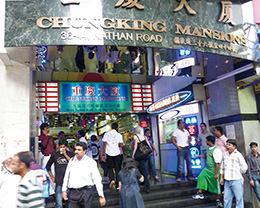
 Prof. Gordon Mathews project on Chungking Mansions is featured in the 22nd issue of the Research Grants Council (RGC)’s newsletter, Research Frontier.

 Chungking Mansions as a 'Global Building'

Chungking Mansions is a building full of cheap guesthouses, restaurants, and wholesale businesses located in the heart of Hong Kong’s tourist district of Tsim Sha Tsui. It is where traders, merchants, temporary workers, and asylum seekers from South Asia and sub-Saharan Africa come to seek their fortunes. In this research, I sought to understand the people in Chungking Mansions: how exactly they make their livings and comprehend their lives. This was pursued through extended ethnographic research, living in Chungking Mansions for 250 nights over four years, interacting with and interviewing its residents, and accompanying traders and merchants to China, India, and Africa to learn about the global context of their trades and lives.

I found that Chungking Mansions serves as a central hub of what I term ‘low-end globalization’. This is the globalization of cheap, often copy goods smuggled across borders, largely under the radar of states and laws; this is globalization as experienced by most of the world’s people. I estimate, on the basis of extensive interactions with merchants, that 20% of the mobile phones in sub-Saharan Africa have passed through Chungking Mansions. The building exists as a hub of low-end globalization because, due to Hong Kong’s flexible visa policies, it serves as an intermediary between South China manufacturers and developing-world entrepreneurs. South China, with its massive production of cheap goods, plays an essential role in spreading the fruits of globalization to South Asia and sub-Saharan Africa, areas that otherwise would not be able to experience globalization; Chungking Mansions, under Hong Kong’s neoliberal rule of law, facilitates this process.

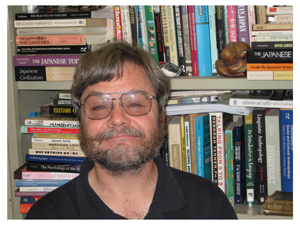
Prof Gordon Mathews (first from the right)
I also found out much about all the other kinds of people in the building, including asylum seekers, who provide the building with its intellectuals as well as its cheapest labor; Pakistani merchants, who may have lived in Hong Kong for generations; Indian temporary workers flying back and forth between Hong Kong and Kolkata every 42 days, carrying goods to finance their journeys; tourists from all over the world staying in the building’s guesthouses; Indian and African sex workers plying their trade and dreaming of becoming middle-class; and Nepalese heroin addicts surrendering their families’ dreams. All these people play key roles in Chungking Mansions’ low-end globalization.

The primary result of this research is a book explicating Chungking Mansions through the anthropological lens of globalization, Ghetto at the Center of the World: Chungking Mansions, Hong Kong (The University of Chicago Press, 2011). This book depicts the building, the people in it, the goods that pass through it, the laws that constrain it, and what it can tell us about the world’s future. Chungking Mansions will eventually vanish, but our increasingly borderless world will become more and more like Chungking Mansions, the book predicts. My research on Chungking Mansions has been profiled in Time Magazine, BBC, CNN, and the Financial Times; the Ghetto at the Center of the World book has been favorably reviewed in the Wall Street Journal, The Economist, the Los Angeles Review of Books, and the Times Literary Supplement, among other newspapers and magazines, and is now being translated into several languages.

Prof Gordon MATHEWS
Department of Anthropology
The Chinese University of Hong Kong
cmgordon[AT]cuhk.edu.hk 

To read the whole issue, please visit the RGC website.