Wednesday, November 27, 2013

[Publication] Gender and Family in East Asia


Professor Siumi Maria TAM and Dr. WANG Danning from our department have co-edited a book entitled Gender and Family in East Asia with Professor Wai-Ching Angela Wong from the Department of Cultural and Religious Studies. The book is going to be first published on 4th February 2014, and is now available for pre-order on Routledge website.

Gender and Family in East Asia belongs to the Routledge Research on Gender in Asia Series, and covers a broad range of research papers on gender politics and family culture in East Asia. It is generally divided into three main sections, including Marriage and Motherhood, Migration, and Religion and Family. The details of the book are listed below.

Book Description
The on-going reconfiguration of geo-political and economic forces across the globe has created a new institutional and moral environment for East Asian family life and gender dynamics. Indeed, modernization in East Asia has brought about increases in womens education levels and participation in the labour force, a delay in marriage age, lower birth rates, and smaller family size. And yet, despite the process of modernization, traditional systems such as Confucianism and patriarchal rules continue to shape gender politics and family relationships in East Asia.

This book examines gender politics and family culture in East Asia in light of both the overwhelming changes that modernization and globalization have brought to the region, and the structural restrictions that women in East Asian societies continue to face in their daily lives. Across three sections, the contributors to this volume focus on marriage and motherhood, religion and family, and migration. In doing so, they reveal how actions and decisions implemented by the state trigger changes in gender and family at the local level, the impact of increasing internal and transnational migration on East Asian culture, and how religion interweaves with the state in shaping gender dynamics and daily life within the family.

With case studies from across the region, including South Korea, Japan, mainland China, Taiwan, and Hong Kong, this book will be of great interest to students and scholars of Asian studies, gender studies, anthropology, sociology and social policy.

Tuesday, November 26, 2013

[Upcoming Seminar] Transnational Business Networks and Circumscribed Mobility Among Undocumented African Migrants in Guangzhou


Transnational Business Networks and Circumscribed Mobility Among Undocumented African Migrants in Guangzhou

Speaker: LAN Shanshan
(Research Assistant Professor, David C. Lam Institute for East-West Studies, Hong Kong Baptist University)
Time:  12:30 p.m. , Friday, 29 November 2013
Venue: Room 11 Humanities Building, New Asia College, CUHK

******************************************************
Based on ethnographic fieldwork within the African diaspora communities in Guangzhou, this talk examines the structural constraints faced by undocumented Africans in urban China and their various coping strategies. Specifically, it focuses on illegal residence as a business strategy in maintaining vital transnational trade networks between China and Africa. For many African migrants, illegal residence in Guangzhou is just one special phase of their life for the purpose of capital accumulation. It enables them to maintain a transnational advantage over traders in Africa. By voluntarily choosing a life style of circumscribed mobility in Guangzhou, undocumented African migrants have been playing an important role in facilitating transnational trade activities between China and their home countries.


ALL INTERESTED ARE WELCOME
Feel free to bring your box lunch or sandwich to eat during the talk

Tuesday, November 19, 2013

[Publication] Museums in China: Power, Politics and Identities


Good news! Professor Tracey L-D Lu is publishing her second book in 2013 entitled “Museums in China: Power, Politics and Identities” on November 28. This book belongs to the Routledge Studies in the Modern History of Asia series, and is now ready for pre-order on Amazon. It is also being used as one of the readings for her course Museum and Anthropology taught in fall 2013-2014. Please find more information of the book below.


Book Description
The origin and development of museums in mainland China differ significantly from those in the West. The occurrence of museums in mainland China in the late nineteenth century was primarily a result of internal and external conflicts, Westernization and colonialism, and as such they were never established solely for enjoyment and leisure.

Using a historical and anthropological framework and based on extensive archive studies and fieldwork, this book provides a holistic and critical review on the establishment and development of museums in mainland China from 1840 to the present day, and argues that museums in mainland China have been used by a wide range of social, political, and state actors for a number of economic, religious, political and ideological purposes, ranging from reinforcing social segmentation, to influencing the economy, to protecting cultural heritage and the construction and enhancement of ethnic identities and nationalism. Further, museums have throughout their history helped the powerful to govern the less powerful or the powerless. The book also provides comparative insights on museology and heritage management, and questions who the key stakeholders are, how museums reflect broader social and cultural changes, and the relationship between museum and heritage management.

Thursday, November 14, 2013

[Invited Seminar] Material Civilization and Hygienic Modernity: Reflections on Toilet Practices in Rural South China


Gonçalo SANTOS 
Assistant Professor, Hong Kong Institute for the Humanities and Social Sciences, University of Hong Kong
Material Civilization and Hygienic Modernity: Reflections on Toilet Practices in Rural South China 
8 November 2013 


Fieldwork in China
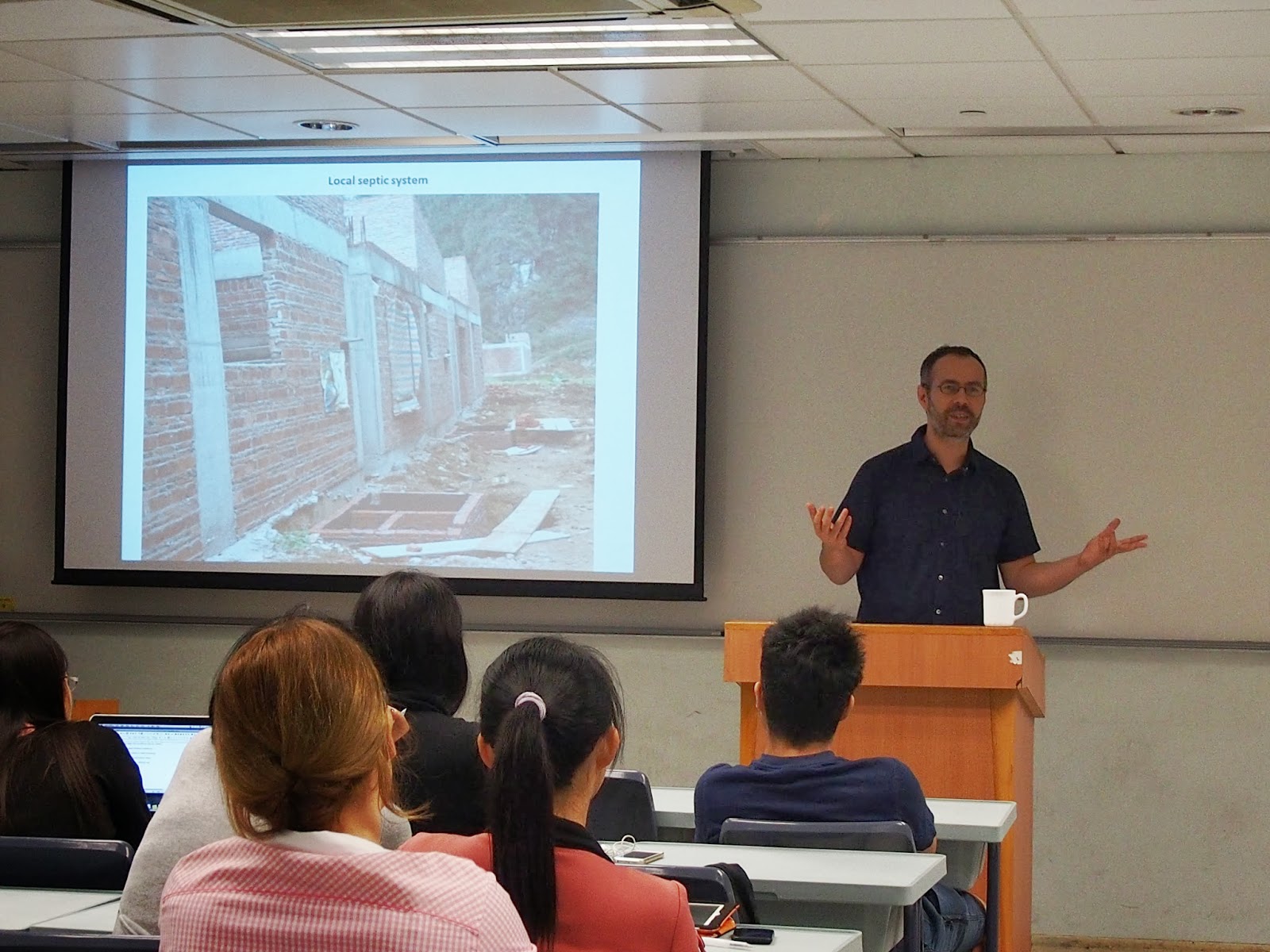
When anthropologists firstly go into the field, one of the most important issues is to figure out where to go to the toilet. Gonçalo Santos, an assistant professor at the University of Hong Kong, recently gave a fascinating talk about people's toilet practices in rural south China based on his field work in Yingde, Guangdong Province from 1999 to 2001.


Local urine buckets vs. 'advanced' toilet arrangements
-- the local flush toilet
When he began his fieldwork, families were mostly going to the surrounding field or to public latrines which are far away from the living quarters or using buckets. A few families had begun to build the "modern" style private toilet and bathroom inside the house.  It seemed that people chose where to go to the toilet based on the development of technology. However, according to Dr. Santos's observation, even families with a "modern" flushing toilet keep on using the indoor-buckets and even the public latrines. The main reason initially was the value of human waste as  effective fertilizer. Even after they stopped using nightsoil as fertilizer, many villagers said that using indoor-buckets rather than flushing is much cheaper, more convenient, and uses less water. Without a proper sewage system, many bathrooms flooded because of excess water flowing into the septic system. Dr. Santos argued that technological choices are not independent from the social relationships and cultural values, but are socially and culturally constructed. The reason for the popularity of flushing toilet is not how efficient the technology is, but how it becomes a symbol of modernity in the villagers' imagination.
Local septic system


Reviewed by 
JIANG Yan (Echo)
M.Phil. Candidate

Tuesday, November 12, 2013

[Publication] 稻作與史前文化演變


Professor Tracey Liedan LU published her new book in Chinese--《稻作與史前文化演變》 early this year. Please find more details of the book below.


內容簡介

《稻作與史前文化演變》綜合已發表的考古學和自然科學資料、作者進行野生稻栽培實驗的結果及對現代稻作社會的觀察,討論稻作的產生和發展與長江中下游及鄰近地區史前文化發展的關係,提出定居是將野生稻馴化為栽培稻的必要條件之一,並且為私有財產的積累提供了條件。
稻作的發展不僅引起了史前社會結構的巨大變化,包括社會分工和專業化的出現,農田作為財產觀念的產生,貧富差別的出現和增大,群體身份認同和領地意識的出現等,而且嚴重影響了野生動植物資源的數量和多樣性,導致史前稻作社會的狩獵採集經濟成分逐漸下降甚至消失,迫使人類依靠馴養的動植物來生存,也導致自然環境的惡化。

    本書適合於從事歷史、考古、社會學等學者及相關院校師生閱讀與參考。

Thursday, November 7, 2013

[Event] Anthropology Department Geopark Boat Tour


On October 26, the Postgraduate Students' Society of Anthropology Department organized a boat trip to Hong Kong Geopark (香港地質公園) with a portion of the fee subsidized by the department. All together 36 postgraduate students along with teachers joined this Eco-Tour in Sai Kung area.

The Group at a 300-year-old Tin Hau Temple on High Island

Hong Kong Geopark became a National Geopark in October 2009 and consists of amazing rock landscapes expanding widely over the coastal area of northern east Hong Kong, which reveals an important part of Hong Kong’s natural history.

An unusual cave near High Island

Yacht trip on Sai Kung inland sea


The yacht tour started from Sai Kung New Public Pier and covered a large range of places including Hebe Haven(白沙灣), High Island(糧船灣), Ung Kong Group(甕缸群島), Tiu Chung Chau(吊鍾洲), and Half Moon Bay(半月灣), etc. During this trip, the group had a chance to observe the hexagonal columnar joints(六角柱節理) and Tiu Chung Cave (吊鐘洞), which is one of the “four famous caves in East Sea”. The group made one stop to visit a Tin Hau temple(天后廟), where fisher folk were drying small fish on the plaza.

Landing on High Island


Fisher folk drying small fish on the plaza

The Group

Monday, November 4, 2013

[Upcoming Seminar] Material Civilization and Hygienic Modernity: Reflections on Toilet Practices in Rural South China


Material Civilization and Hygienic Modernity: Reflections on Toilet Practices in Rural South China 

Speaker: Gonçalo SANTOS 
(Assistant Professor, Hong Kong Institute for the Humanities and Social Sciences, University of Hong Kong )
Time:  12:30 p.m. , Friday, 8 November 2013 
Venue: Room 11 Humanities Building, New Asia College, CUHK

******************************************************
We have come to assume that the flush toilet and the wider waterborne system of waste disposal is one of the requirements of an urban setting and one of the symbols of an ‘advanced’ society. In this paper, I would like to explore the role played by the ‘flush toilet’ and the question of human waste management in the making of ‘modern identities’. My account is ethnographic in that it focuses on the spread of the ‘flush toilet’ in a specific setting - a rural community in South China -, but my theoretical goal is more general. I argue that ‘technological choices’ result less from inherent benefits in the technologies being adopted than from specific cultural values and social relations. Rather than treating technology independently of the human relations surrounding their use, I argue that technology is a socially and culturally constructed means of action upon the physical world. 


ALL INTERESTED ARE WELCOME
Feel free to bring your box lunch or sandwich to eat during the talk

Tuesday, October 29, 2013

[Invited Seminar] Treating Crazy: Becoming a Hong Kong Psychiatrist


Hanna MANTILA 
PhD Candidate, Department of Social Anthropology, University of Edinburgh and Honorary Research Assistant, Department of Anthropology, The Chinese University of Hong Kong
Treating Crazy: Becoming a Hong Kong Psychiatrist
18 October 2013


“Treating crazy” was a talk that focused on psychiatrists, specifically on the process of becoming a psychiatrist, to understand how the social stigma associated with mental illness can also have a negative impact on how clinicians experience their work. Ms Hanna Mantila locates doctors at one point in a complex network that includes classification (i.e. diagnostic practice), institutions (the health care system), experts (the psychiatrists), knowledge (biomedical knowledge in this case), the people (the mentally ill patients), and international organizations and pharmaceutical companies. Medical anthropologists commonly study the “illness experience” and clinical encounters from patients’ perspectives, but Ms. Mantila put the psychiatrists at the center of her analysis, demonstrating how systemic tensions and social ideas affect socialization and professionalization. 

Ms. Mantila noted that there are only around 300 psychiatrists in Hong Kong, which is a rather small number considering the population and the needs of Hong Kong. Patients have very long waiting times (even three weeks for the most urgent of cases in child psychiatry), because examination time and resources are limited. This can also affect the quality of supervision trainees receive from their supervisors, and psychiatrists’ ability to offer “psycho-education” to patients, i.e. the importance of staying on a drug regimen even when they feel well.   


In her presentation, Mantila presented a number of personal accounts given by Hong Kong psychiatrists’, and urges us to understand the difficulties these doctors face. She also discussed how the severe stigmatization of patients in Hong Kong makes halfway homes nearly impossible to open, which forecloses the institution of community-based alternatives to hospitalization. 

Ms. Mantila spoke about her initial findings as she only recently completed a year of fieldwork. The talk made listeners aware of the cost of the “efficiency” of Hong Kong’s public medical system, and to consider how global forms of expertise and medical practice are always shaped by  a given social and economic context. 


Wednesday, October 23, 2013

[In the Press] Professor Joseph Bosco Talks About Ghosts and Fengshui in Chinese Culture


Professor Joseph Bosco was interviewed for a radio documentary about ghosts and fengshui in Chinese culture. RTHK Radio 3 has decided to play this documentary during this time between Chung Yeung and Halloween. 

What are the differences between ghosts in Chinese and other cultures? Should the belief in ghosts be called superstitious? How about fengshui? And what different types of ghosts do anthropologists identify?

Click here to listen on the RTHK Radio 3 Archive programme "Ghostbusting Hong Kong" to what Professor Bosco has to say.

Monday, October 21, 2013

China Youthology: Anthropological Methods applied in Consumer Insights Consultancy


What can you do after graduation with an anthropology major? How can one apply anthropological methods in real jobs and in everyday life? These may be questions that bother lots of students. Well, here is an example of what to do with anthropological training. 

A group of young people established this company called China Youthology, which is now one of China's top Consumer Insights consultancies. Many of the members have anthropological background and the company has been applying methods such as in-depth interviews and focus-group discussions into their research, to help companies and society understand the real life and needs of Chinese youth.

As they put it:"We offer provocative insights about Chinese youth and facilitate the use of insights to spark actions in the market and society."


To find out more about their work with companies and their research, please visit their company website and blog. You can also check out their recent project "China Normal: Lower Tier Youth Research" here.

Graduates interested in job openings can also check them out here.