Wednesday, October 23, 2013

[In the Press] Professor Joseph Bosco Talks About Ghosts and Fengshui in Chinese Culture


Professor Joseph Bosco was interviewed for a radio documentary about ghosts and fengshui in Chinese culture. RTHK Radio 3 has decided to play this documentary during this time between Chung Yeung and Halloween. 

What are the differences between ghosts in Chinese and other cultures? Should the belief in ghosts be called superstitious? How about fengshui? And what different types of ghosts do anthropologists identify?

Click here to listen on the RTHK Radio 3 Archive programme "Ghostbusting Hong Kong" to what Professor Bosco has to say.

Monday, October 21, 2013

China Youthology: Anthropological Methods applied in Consumer Insights Consultancy


What can you do after graduation with an anthropology major? How can one apply anthropological methods in real jobs and in everyday life? These may be questions that bother lots of students. Well, here is an example of what to do with anthropological training. 

A group of young people established this company called China Youthology, which is now one of China's top Consumer Insights consultancies. Many of the members have anthropological background and the company has been applying methods such as in-depth interviews and focus-group discussions into their research, to help companies and society understand the real life and needs of Chinese youth.

As they put it:"We offer provocative insights about Chinese youth and facilitate the use of insights to spark actions in the market and society."


To find out more about their work with companies and their research, please visit their company website and blog. You can also check out their recent project "China Normal: Lower Tier Youth Research" here.

Graduates interested in job openings can also check them out here.


Tuesday, October 15, 2013

[Upcoming Seminar] Treating Crazy: Becoming a Hong Kong Psychiatrist


Treating Crazy: Becoming a Hong Kong Psychiatrist

Speaker: Hanna MANTILA 
(PhD Candidate, Department of Social Anthropology, University of Edinburgh and 
Honorary Research Assistant, Department of Anthropology, The Chinese University of Hong Kong)
Time:  12:30 p.m. , Friday, 18 October 2013
Venue: Room 11 Humanities Building, New Asia College, CUHK

******************************************************
This research discusses psychiatrists as mediators between systems of health care, patients and Hong Kong society and culture. As they are delicately positioned between numerous forces - institutional, social, cultural, economic and political, studying psychiatrists and their experiences of being doctors can help reveal how institutions come together in what are highly complex assemblages. Drawing on recent ethnographic fieldwork, this talk, as a preliminary reflection on the data, will look at the initial becoming of the doctors. By outlining what brings students to study psychiatry in Hong Kong, the expectations placed upon and emerging from aspiring doctors and the negotiation of these expectations, this talk creates space for exploring what studying clinical practice and experience could tell us about mental health and illness, about Hong Kong society, and about being human in the contemporary world. 


ALL INTERESTED ARE WELCOME
Feel free to bring your box lunch or sandwich to eat during the talk

Thursday, October 3, 2013

[Invited Seminar] Goodbye iSlave: Foxconn Labor and Networked Resistance


Jack Linchuan QIU 
Associate Professor, School of Journalism and Communication, The Chinese University of Hong Kong
Goodbye iSlave: Foxconn Labor and Networked Resistance 
27 September 2013


When you heard the shocking information about 19 Chinese Foxconn workers’ suicide attempt ever since 2010, you must be sympathy towards them. Linchuan Qiu feels the same way, but he goes further. 

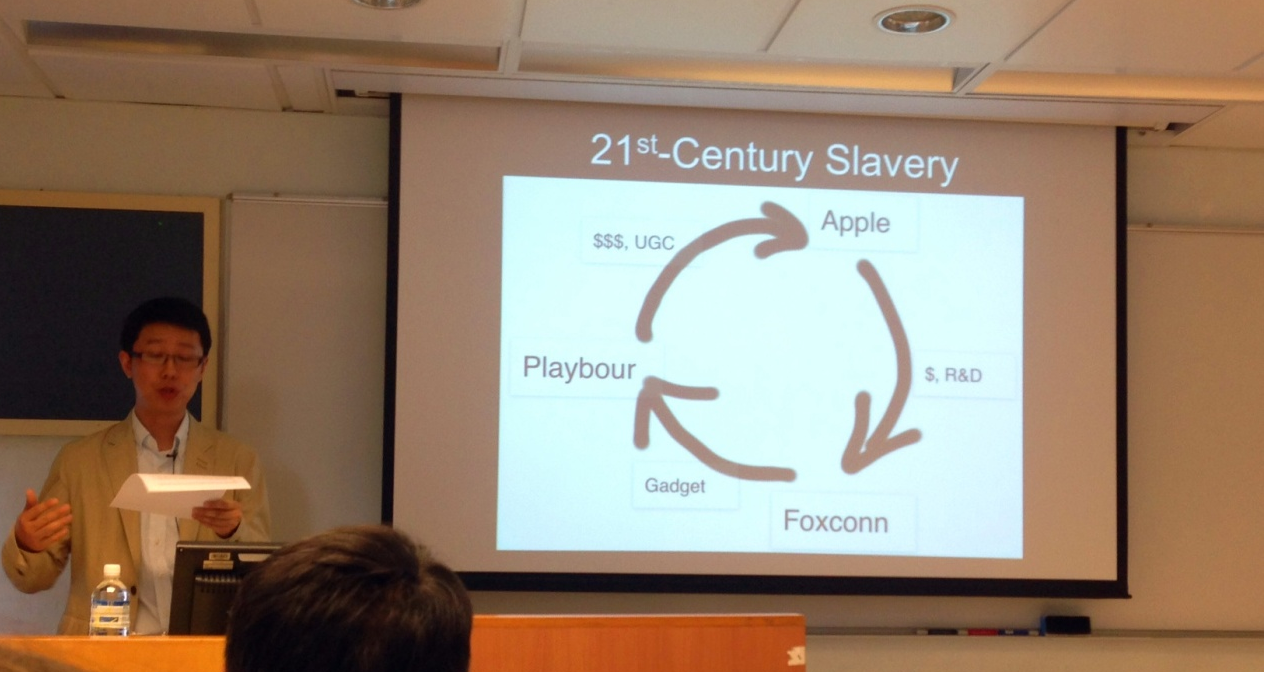
From Qiu’s perspective, all of us who are now using Apple laptops or iPads or other smartphones to skim this review, are quite similar to those Foxconn iSlaves who produce those e-products.  Qiu called the Foxconn workers the manufacturing iSlaves, rural-to urban migrants, working for low pay, in poor conditions, making gadgets and exploited by cadre capital and global capital. We (and he includes himself) are manufactured iSlaves, consumers influenced by marketing, culturally absorbed, making UGC (user generated content), and exploited by western capital. These two types of iSlaves share these following commonalities: long work time, body discipline, and atomized social life. 

In his fascinating Friday Seminar talk “Goodbye iSlave: Foxconn, Labor & Networked Resistance” on 27 September 2013,Jack Linchuan Qiu showed the parallels between 17th century slavery and 21st century slavery (See pic.3), challenging our stereotype that “slavery only exists in ancient history”. In the wonderful Q & A section, Prof. Qiu advocated, “Do not look down upon those physical laborers; they are reconnected and empowered by technology, generating WGC (working-class generated content), expanding their working-class networks and the public sphere.” Indeed, workers are becoming more aware and we are increasingly hearing their voices seeing their efforts to resist. But is it enough? 

[pic.3] 21st-Century Slavery


Reviewed by 
Qianni WANG
M.Phil. Candidate

Wednesday, October 2, 2013

"An Indian...made in China" a talk by a stand-up comedian Vivek Mahbubani


Speaker: Vivek Mahbubani (stand-up comedian)
Time: 2:30-3:45p.m., Saturday, 5 October, 2013
Venue: Rm12, Humanities Building, New Asia College, The Chinese University of Hong Kong
Language: Cantonese

Lecture presented by: Multiculturalism in Action: Indian Culture Workshop
Organizer: Prof. Siumi Maria Tam.

About Vivek Mahbubani:
-Born and raised in Hong Kong
-Interviewed by RTHK and newspapers 
-Funniest Person (in Chinese) in Hong Kong 2007
-Winner of the Hong Kong International Comedy Competition (English category) 2008

FREE!
ALL INTERESTED ARE WELCOME!


Wednesday, September 25, 2013

We've Started Accepting Applications for MPhil/PhD Programmes 2014-15!


Here is some brief application information of the MPhil/PhD programmes of the Department of Anthropology at CUHK. For more details please visit the Department's homepage.


Programme
MPhil in Anthropology
It normally takes two years (full-time) to complete 28 units. Students must also pass a General Anthropology Examination based on a department reading list.

PhD in Anthropology
The programme is research-oriented. A student may be asked to take additional courses or tutorials, and will be required to present an annual written progress report to his/her supervisor. After passing Qualifying Exams, the student advances to PhD Candidate. Within six months of candidature, the PhD Candidate must submit a Research Proposal for a project requiring nine to twelve months of fieldwork. On return from fieldwork, the student will prepare a thesis based on fieldwork research.

Fields of Specialization
The Division focuses geographically on Chinese culture and society (especially South China) and on East and Southeast Asian Studies. Research topics include nationalism, ethnicity, religion, gender, development and social change, urban and youth cultures, heritage management, archaeology and museology.

Admission Requirements

MPhil in Anthropology
Applicants should have majored in anthropology or related fields.

PhD in Anthropology
Applicants should possess a master's degree in anthropology from CUHK or other recognized universities. Applicants with a background in fields other than anthropology may be considered for conditional admission.

Additional Application Information
Applicants are required to furnish proof of their research capability by submitting academic references, transcripts, samples of writings or publications such as thesis or project reports, and a statement of purpose (2-3 pages) describing why the applicant wants to study anthropology at CUHK and what research project the applicant proposes to carry out. If relevant for research, some evidence of Chinese proficiency is also required for non-native speakers.

Admission Advisor: Prof. Joseph BOSCO

Application Deadline:
2 December 2013
For applicants who apply for PhD programme through the Hong Kong PhD FellowshipScheme (HKPFS)
31 January 2014
For applicants who apply for MPhil/PhD programme directly with CUHK (i.e. non-HKPFS applicants)


Monday, September 23, 2013

[Upcoming Seminar] Goodbye iSlave: Foxconn Labor and Networked Resistance


Goodbye iSlave: Foxconn Labor and Networked Resistance

Speaker: Jack Linchuan QIU
(Associate Professor, School of Journalism and Communication, The Chinese University of Hong Kong)
Time:  12:30 p.m. , Friday, 27 September 2013
Venue: Room 11 Humanities Building, New Asia College, CUHK

*****************************************************************
Focusing on the case of Foxconn, this talk discusses 21st-century slavery in an era of information echnology, global connectivity, and local disconnect. It proposes the heuristic notion of "iSlavery", while examining networked activism against labor abuse at the world’s largest electronics factory. Drawing from three years of fieldwork and multimedia action research, this talk will be a provocative intervention to help rethink issues of labor and technology, network and resistance, class formation and cultural transformation, including the possibilities for a post-capitalist world system that is, at last, slave-free. 


ALL INTERESTED ARE WELCOME
Feel free to bring your box lunch or sandwich to eat during the talk

Sunday, September 22, 2013

[Event] Field Study Tour Exhibition 2013: Inheritors


Opening Ceremony: 12:00 p.m., 23 September 2013 (Change of date to 24 Sept. in case of Typhoon)
Exhibition Date: 2013.09.23 - 10.04
Venue: Hui Gallery, New Asia College, The Chinese University of Hong Kong
Opening hours of Hui Gallery: 
9:30am-4:30pm (Monday to Friday); 9:30am-12:00noon (Saturdays); Closed (Sundays and Public Holidays).

Based on the Spring Field Trip led by Prof. Sidney Cheung in Nagoya, Japan, students of Anthropology Department further conducted their research this summer on the subject of "Inheritors", to explore the preservation and transmission of traditional culture in Hong Kong. 
This exhibition displays their Summer Field Study, which covers 19 different projects vary from food to traditional art and handicrafts. All interested are welcome!

***********************************************************
香港中文大學人類學系2013年田野考察成果展覽——『知識傳承』

开幕时间:2013年9月23日中午12:00 (如遇八號颱風則改期為24日)
展覽日期:2013年9月23日~10月4日
展覽地點:香港中文大學 新亞書院 許氏文化館
許氏文化館開放時間:星期一至五,上午9:30至下午4:30,星期六上午9:30至12:00,星期日及公眾假期休息

二零一三年三月二十九日至四月五日,二十位人類學本科同學跟隨張展鴻教授到日本名古屋進行了主題爲『傳承人』的田野考察。在日本之行的啟迪下,同學們又進一步於暑假期間對香港的文化傳承進行了更深入、多角度的考察與探討。
本期名為『知識傳承』的展覽即是對人類學系本科同學2013年度春季和暑期田野考察的總結及成果展示。展覽涉及的主題十分豐富,從涼茶舖到手打魚蛋,從粵劇到傳統花牌,從面線師到東陽木雕等等,遍及飲食、傳統藝術和手工藝等19個主題。歡迎感興趣的同學前來參觀!


Wednesday, September 18, 2013

[Invited Seminar] “City Cowherds”: Migrant Youth Coming of Age on China’s Peri-Urban Edge


Dr. LING Minhua 
Assistant Professor, Centre for China Studies, The Chinese University of Hong Kong
“City Cowherds”: Migrant Youth Coming of Age on China’s Peri-Urban Edge
13 September 2013


In 2010, there were more than 21 million second-generation internal migrants in China. One out of three children in Shanghai does not have a city hukou (household registration). Based on 24 months of ethnographic fieldwork, Dr. Ling’s vivid presentation explores how school-age migrant youth in Shanghai oscillate between the “rural” and the “urban”—hence the title “city cowherds”. Ling’s research paints a nuanced picture of these city cowherds—that are not merely victims of the discriminatory social structure, but persons in a state of “in-betweenness” with aspiration.

The migrant youth in Ling’s study cluster in the peri-urban edge of Shanghai where living condition is poor; the more well-to-do ones often rent an apartment together with other migrant families in sub-urban gated neighborhoods. Typically, they came with their parents from their rural hometown to Shanghai since a young age, and have never gone back. Growing up in Shanghai, they all speak fluent Putonghua in public places. Most of them understand some Shanghai dialect, though few can speak it well; most of them cannot speak their hometown dialect very well either. Their parents are generally self-employed small entrepreneurs who, unlike migrants working as wage laborers, have more flexibility in their work and living condition. This enables them to bring their children to the city.


Without a city hukou, these migrant youth are denied access to many public provisions in the city. Some public schools segregate migrants and natives into separate teaching buildings. The Shanghai city government is clear about its intention to channel these migrant youth into the low-end manufacturing or service industry, thus reproducing the existing urban vs. rural social hierarchy. For example, the native-place-based college entrance exam (gaokao) rule forbids migrant students from taking the exam in Shanghai. This in effect creates a glass ceiling, as they cannot continue formal education in the city beyond grade nine. Therefore, many of them go for a three-year vocational schooling in Shanghai. Those studying in vocational schools are stigmatized as “bad students” and are routinely discriminated against in job placement.

In response to the larger structure set against them, these migrant youth resisted passively. Some simply slack off in school. Many find a part time job after school.  With the money they earned, they—just like other youth growing up in the city—pursue youthful lifestyle through consumption activities, like dining out, window shopping, and wearing trendy clothes. These leisure activities may seem trivial, but Ling argues that through these activities the migrant youth learn the urban knowledge necessary to thrive in the city. They make friendship across the rural-urban boundary, which is uncommon for their first-generation migrant parents. Therefore, the migrant youth embody the “peri-urban edge”. Despite the stigma against them, they are not marginalized victims of the larger structure, but “city cowherds” falling in between the “edge” of the rural-urban categories who are able to act flexibly on “malleable socio-cultural meanings in different contexts to maximize access to material and symbolic resources”.

With great ethnographic depth, Ling’s research tells a vivid story of who the city cowherds are, what challenges they face, and how they respond to such challenges. It deepens our understanding of internal migrants in China and the problems of the hukou system.

Reviewed by
Alan TSE
M.Phil. Candidate

Friday, September 6, 2013

Welcome to the Friday Seminars of Fall 2013


Welcome back for a new academic year! You are cordially invited to attend the seminars presented by the Department of Anthropology. All interested are welcome. Bring your sack lunch and join the talk with us!

*Seminars take place 12:30-2:00 p.m. in Room NAH401, Humanities Building, New Asia College, CUHK.
(Note that venue for seminars on 13 Sept and 27 Sept will be changed to Room NAH 11, Humanities Building)


【13 Sept】 LING Minhua (Assistant Professor, Centre for China Studies, CUHK)
"“City Cowherds”: Migrant Youth Coming of Age on China’s Peri-Urban Edge." (Venue: NAH 11)

【27 Sept】 Jack Linchuan QIU (Associate Professor, School of Journalism and Communication, CUHK)
"Goodbye iSlave: Foxconn Labor and Networked Resistance." (Venue: NAH 11)

【18 Oct】 Hanna MANTILA (PhD Candidate, Department of Social Anthropology, University of Edinburgh, and Honorary Research Assistant, Department of Anthropology, CUHK)
"Treating Crazy: Becoming a Hong Kong Psychiatrist."

【25 Oct】 PUN Ngai (Professor, Department of Applied Social Sciences, Hong Kong Polytechnic University)
"Desiring the iPhone and Worker Suicide."

【8 Nov】 Gonçalo SANTOS (Assistant Professor, Hong Kong Institute for the Humanities and Social Sciences, University of Hong Kong)
"Material Civilization and Hygienic Modernity: Reflections on Toilet Practices in Rural South China."

【29 Nov】 LAN Shanshan (Research Assistant Professor, David C. Lam Institute for East-West Studies, Hong Kong Baptist University)
"Transnational Business Networks and Circumscribed Mobility Among Undocumented African Migrants in Guangzhou."