Thursday, January 10, 2019

【講座回顧】考古現場的多視角三維重建


日期:2017年11月7日
地點:香港中文大學聯合書院考古實驗室
講者:劉建國(中國社會科學院考古研究所研究員)
題目:考古現場的多視角三維重建
文:黃珮琳 (研究助理)


考古發掘過程需要把一層一層的發現記錄下來,日後向公眾展示。考古工作者一般會在考古現場拍照和作文字記錄,但這些都只是二維的資料。人們生活在三維空間中,三維訊息的展示最符合的人們的習慣。隨着考古學研究和文化遺產保護的不斷深入,以及三維訊息獲取技術的飛速發展,考古工作中全方位空間訊息的獲取顯得越來越重要。中國社會科學院考古研究所研究員劉建國老師在2017年11月7日到訪我系並以「考古現場的多視角三維重建」為題,從攝影測量原理、多視覺影像三維重建、超低空拍攝與三維重建以及「大疆精靈4」(Phantom4)遙控飛機拍攝四方面講述最新的三維重建技術。

根據劉老師所述,以往一般會使用激光掃描,但是這種技術花費較高、操作比較複雜,只有少部分考古工作者懂得使用,而且在大範圍應用中不夠精準,有許多誤差。為此,中國考古研究中引進了數字近景攝影測量與三位激光掃描等系統,用於對考古為止發掘區域、石刻、造像、乃至器物進行三位訊息提取,生成地面或石刻、古建築立面的各種綫劃圖、等值綫腳圖、數字高程模型、正射影像圖和三圍數字模型等產品,滿足各種文物考古工作的需要。

首先,攝影測量是一門通過攝影,對所獲得的影像進行測量的學科測量。攝影的基本原理是前方交會方法,在兩個已知的控制點(A 、B)上加設全站儀,分別測量水平角∠PAB 、∠PBA和BP方向的坐標值,然後根據測量數據與已知點A和B的座標值計算未知點P的座標。攝影測量是在被測物體前的兩個已知位置(攝影站或攝影中心)攝取兩張影像,然後在室內利用攝影測量儀器測左右影像相同名點(即空間同一個點,在左、右影像上的像點)的影像座標交會得到空間點的三維座標。因為左右影像是同一個空間物體的投影,所以利用影像上任意一對同名點都能交會得到一個對應空間點和其座標。攝影測量不僅可以測量一個空間的點,而且能夠利用影像重建和測量空間三維物體的模型,對影像進行測量。劉老師指出投影差產生的像點位移問題,無論是起伏的地形還是高出地面的事物,在照片中與其平面位置相比會產生位置的移動,三維重建軟件能解決這些誤差並建立空間關係。

多視覺影像三維重建技術是普通數碼相機作為影像獲取工具,從不同角度圍繞被拍攝物體獲取多幅數碼影像,然後根據計算機視覺原理,對獲取的全部數字影像進行相互匹配,生成被拍攝物體的表面三維點雲,加載影像數據後得到真實的三維模型。野外工作主要是測量控制點和拍攝影像一般先使用電子全站儀測量4個控制點,用作攝影測量數據處理的過程中絕對定向,並將測量對象置入特定的三維直角坐標系統中。紅黃配搭的標誌會更清晰。

劉老師特別指出,拍攝影像的數量和採用鏡頭的焦距應該根據現場情況而定。相鄰影像的重疊度至少須大於80%,交會個不少於5°,並需盡量減少樹木等的遮蔽以免降低匹配成果。所拍攝的目標要充滿整幅影像的八成以上,不同影像上的同一地物應該大致相等。控制點座標需要使用電子全站二儀或實時動態技術 (Real Time Kinematic, RTK) 進行測量。電子全站儀測量精度高,特別是使用免棱鏡方式直接瞄準控制中心進行測量時,能夠得到3至5毫米的測量精度。而使用棱鏡測量時,應該盡量降低棱鏡的高度以提高測量精度。而使用RTK進行測量時的誤差可能達到10 厘米左右。劉老師認為使用相機拍下現場測量的控制點座標,或者直接聯機導出成本文件更好,能避免筆錄時進行抄寫錯誤。劉老師就此解釋拍攝常用的相機設置,例如光圈數值8、10左右,景深好而曝光所須時間亦較短。感光度應在100至400之間,使用手動白平衡和TTL閃光燈模式,並應該在中心單點、單次對焦。如果光線不足、死白或死黑、拍攝角度太斜等便須要大量後期工作,因此在開頭拍一張好照片很重要。他又簡單解釋了如何使用軟件做後期,指出導出影像時TIFF會比JEPG和PNG檔更好,後期處理後輸出的影像質素較佳。其後劉老師再講述深入文物拍攝技巧。文物拍攝時應先擺放座標紙或控制板,擺正文物角度,四個對焦點分別是器物內底、口沿內、口沿外、底部外側。


在超低空拍攝方面,低空空域是指1000米以下的空域,其中200米以下稱為超低空。中國在2013年11月18日實施的《民用無人駕駛航空器系統駕駛管理暫行規定》指出,重量少於或等於7公斤的微量無人機,飛行範圍在半徑500米內、相對高度低於120米的目視視距範圍內無需證照管理。因此一般使用無人機拍攝都會依照這個規定,並留意什麼地方最不能拍照的。控制點標示版的大小應該根據飛行高度和相機焦距來確定。使用全畫幅相機、2千萬像素、21至25 毫米焦距鏡頭拍攝時,相對高度30米內可以使用10 X 10 厘米的控制點標誌板;相對高度在30至60米是可以使用20 X 20厘米的控制點標誌板;相對高度在60至100米時可以使用30 X 30厘米的控制點標示板。標誌板大小合適的時候才能在拍攝的影像中清晰明顯,易於標誌中心位置。另外,拍攝時的飛行高度需要根據影像的分辨率來確定。一般飛行3至4米的相對高度可以獲1毫米的正射影像圖;30至40米的相對飛行高度可以獲得1厘米的正寫影像圖。在相機設置方面,應該選擇短焦距的手動對焦鏡頭,並選擇拍攝範圍內最亮的地面物體進行測光,使最亮地物的照片上曝光合適,其他地物的曝光可以稍為減弱一點。光圈為8左右,使用日光型而非自動白平衡。在數據處理方面,三維重建前需要對全部影像進行篩選,盡量減少參與像素處理的影像數目。沒有樹木、房屋而且地勢平穩的區域相鄰影像應該具有50至60%的航向重疊。相反,較複雜的地貌,相鄰影像需要具有80%左右的航向重疊。200幅而內的影像可以使用6000X4000,超過200幅影像是最好把像素減到3000×2000像素,一次處理的影像數目最好不超過800幅。

最後劉老師介紹中國社會科學院考古研究所使用的無人遙控飛機Phantom4,並從無人機拍攝開始到後期修圖,展示整個三維重建流程,分享各種考古現場和文物拍攝經驗及個案研究。

【文化遺產研究中心講座回顧】「上山下海」四川三星堆及江口古戰場.廣東南海I號沉船遺址:香港中文大學人類學系考古實習成果展系列講座一:四川三星堆遺址的新認識——三星堆古城與器物坑


日期:2018年10月19日 (星期五) 下午4:00-6:00
地點:香港中文大學聯合書院鄭棟材樓C1講室
講者:孫華教授 (北京大學考古文博學院教授及文化遺產保護研究中心主任)
題目:四川三星堆遺址的新認識——三星堆古城與器物坑
文:黃珮琳 (研究助理)

香港中文大學人類學系、文化遺產研究中心、四川省文物考古研究院主辦的《「上山下海」四川三星堆及江口古戰場.廣東南海I號沉船遺址:香港中文大學人類學系考古實習成果展》已於早前順利開幕。展覽系列講座一是「四川三星堆遺址的新認識——三星堆古城與器物坑」,由北京大學考古文博學院教授及文化遺產保護研究中心主任孫華教授主講,吸引了一眾師生和公眾人士出席。


四川廣漢市的三星堆遺址是古代蜀國的中心都城,著名的「祭祀坑」在此發現。隨著成都平原青銅時代考古的快速發展,三星堆遺址考古工作的全面推進,以及兩個器物坑文物復原研究的新成果,大眾對三星堆遺址、三星堆文化和三星堆古代國家也有了全新的認識。孫華教授主要從三方面探討三星堆文明,分別是三星堆的相關背景知識、重要發現及研究成果。
四川盆地被群山環繞,特殊的地理環境造就了其獨特的文化。在秦漢時代的中央政權進入這片土地前漫長的歲月,四川一直處於一種相對封閉、少受外來影響的狀態,使其文化相對獨立並連貫。然而,歷史文獻關於四川或古蜀國的記錄甚少。漢晉時期的文獻雖然有對古蜀的記載,但歷史和傳說神化程度非常高。因此,考古發現和研究成為了解蜀地真實歷史的重要途徑。

孫華教授指出,自1934年三星堆遺址發現至今,已有多個四川不同時期的遺址被發掘和研究,四川的先秦考古學文化序列得以建立,亦將古蜀的歷史由戰國時代上遡至夏代。對於古蜀國的族群構成、統治集團、宗教觀念和社會狀態等方面的認識大增。四川盆地可以被劃分為四個青銅文化,除了新一村文化中心城市尚未發現外,三星堆文化、十二橋文化和巴蜀文化的中心城市都已被確認。80年代四川考古學家對三星堆遺址南部的多次大規模發掘為認識三星堆文化奠下重要基礎,城牆、建築、墓地及器物坑等重要遺存被發現。目前三星堆研究已分辨出三星堆遺址的興起、繁榮、衰落過程。他指出三星堆古城的空間佈局有明確劃分,河流將城市分為南北兩部分,其中南部是宗教祭祀活動,北部則形成並列雙城根據社群階級分隔不同區域。孫華教授認為三星堆文化的人們可能源自陜西關中及陝北地區,與三星堆相似的人面和眼睛形象可以在該地區的西安高陵區楊官寨遺址和神木縣石峁遺址中找到,兩地可能有某種未知聯繫。

此外在宗教方面,三星堆人們的有著原始宗教崇拜。三星堆祭祀坑發掘出三件凸目尖耳的銅面像,一大二小復原後發現銅像應是人首鳥身、頭上有羽冠。當時人們應該以這一主二從的三神像為主要崇拜對象。孫華教授提出這種三神崇拜的思想可能得以延續,四川戰國時代都江堰上的「三神石人」、漢晉時期道教崇拜核心「三官」等都可能是三星堆三神崇拜的影響。三星堆亦有太陽鳥及太陽樹崇拜。器物坑中發掘出兩株高大的銅樹,每根樹枝上各有一鳥,其中一株樹上更有龍盤繞,兩株應屬某種神樹。考古學家結合銅樹器形及《山海經》等古代神話傳說,分析銅樹可能是當中的太陽神樹,分別象徵日出日落的扶桑和若木,反映出當時人們的宗教思想和世界觀。


最後,孫華教授深入淺出地闡釋三星堆國家的族群和統治階級的構成,並從中解釋三星堆文化衰落的可能原因。「祭祀坑」出土的大量青銅人像可根據髮型分為兩類——「辮髮」和「笄髮」。孫華教授指出兩種髮型可能兩個不同的族群,「笄髮」人群是少數,專門從事宗教活動如;「辮髮」人群是社會中的主流,社會階層較低。兩個族群可能出現了權力、財富分配失衡的情況,「辮髮」人群與其他地區某個使用尖底和圜底陶器的族群結盟推翻「笄髮」的統治。另外,孫華教授從三星堆器物坑有大量金、玉等珍貴器物出土而城內外都甚少出土此類器物一點而推測,當時三星堆的上層貴族不單佔據著大量財富,甚至連城外的周邊地區和族群都大肆掠奪資源,令這些地區尤其荒蕪。直至三星堆城被廢棄,這些被壓迫的地區才得以發展。

孫華教授亦提到三星堆文化的技術可能不如一般人想像的高深精細。那些造型特殊、巧奪天工的銅器物,可能並非由三星堆生產而是從其他地方入口。一些發掘出來的器物有拼接的痕跡,而拼接的技術明顯比製作技術低。銅面具的加工鑽孔技術亦比較差。三星堆文化可能並非科技發達的文明,而是以較落後的方式使用武力統治。考古的發現為大眾帶來三星堆古城的演變、佈局、規劃思想及其影響的新看法,使人更了解三星堆國家的族群構成、統治集團、宗教觀念和社會狀態。


【開幕典禮回顧】「上山下海」四川三星堆及江口古戰場.廣東南海I號沉船遺址:香港中文大學人類學系考古實習成果展


文:黃珮琳 (研究助理)

只有通過田野經驗,我們才能明白過去的物質遺存文化,明瞭如何和當下的人溝通,解釋為何我們要在乎過去的盆罐磚瓦。

香港中文大學人類學系考古學副修學生今年在四川和廣東等地參加了各種「上山下海」的考古實習,親身體會調查、整理文物的過程以及遺址背後的意義,學習各類考古技術和國際考古學研究前沿概況。同學通過為期約三個月的展覽展示了他們的實習成果。四川三星堆、江口古戰場及廣東南海I號沉船遺址都先後成為中國全國十大考古新發現,這些考古遺址發掘和研究為中國考古學提供古代人類生活的新知識,具有重要歷史、藝術和科學價值。是次展覽以學生實習經驗為主線,把不同時空的陸上和水下考古發現連繫起來,讓公眾思考古代中國文明的多樣性與差異性,以及廣東和四川在古代絲綢之路的意義。 

三個遺址出土了許多珍貴文物,但本次展覽特別之處在並沒有以文物為重心,而是展出與水陸考古相關的工具、大學圖書館藏豐富的考古報告和圖錄等配合同學的考古實習經歷,令參觀者可以一睹考古發現幕後的點滴,深化著大眾對於歷史和文化遺產的認知。學生亦有機會參與策展。在教授和研究助理的協助下,同學撰寫展覽圖錄和展板內容,把自己的親身經驗和感受轉化為文字。運用課堂上和實習中學習的有關田野考古、公眾考古學、博物館人類學等知識。

展覽開幕典禮於2018年10月19日 (星期五) 在大學圖書館地下的數碼學術研究室舉行,香港中文大學圖書館館長李露絲女士、香港中文大學人類學系系主任麥高登教授、香港中文大學新亞書院副院長朱嘉濠教授、北京大學考古文博學院教授及文化遺產保護研究中心主任孫華教授、一九八一新亞中文系校友中華文化活動基金捐贈人張倩儀女士、香港中文大學人類學系助理教授林永昌教授以及黃慧怡教授一同擔任主禮嘉賓。麥高登教授、孫華教授、林永昌教授、黃慧怡教授以及學生代表鍾禮筠同學先後在開幕典禮上致辭。一眾嘉賓進行了開幕剪綵儀式後,麥高登教授代表人類學系贈送紀念品予嘉賓,之後所有出席者一同觀賞同學們考古實習體驗的短片。展覽於2018年10月15日至12月20日在香港中文大學大學圖書館舉行,附以一系列相關講座。


學生整理展品
林永昌教授與學生一同整理展板
展覽籌備完成!
展覽開幕典禮在大學圖書館地下的數碼學術研究室舉行。
麥高登教授致歡迎辭。
開幕剪綵儀式,左起李露絲女士、黃慧怡教授、麥高登教授、孫華教授、朱嘉濠教授、張倩儀女士及林永昌教授
麥高登教授致送紀念品予李露絲女士
北京大學考古文博學院孫華教授和人類學系教授和學生交流 
開幕典禮後的茶會

[Friday Seminar Recap] Making Pots in Mainland Southeast Asia


Date: 7th September 2018 (Friday)
Time: 1:00 – 2:30 pm
Speaker: Louise Allison CORT (Curator, Ceramics Freer Gallery of Art and Arthur M. Sackler Gallery Smithsonian Institution)
Venue: Room 12 Humanities Building New Asia College, CUHK

Text: Wong Pui Lim (Research Assistant)


Potters at work today in rural villages of Thailand, Laos, Cambodia, Vietnam, Malaysia, and southern Yunnan province, PRC, make earthenware or stoneware for local and regional markets. Although under pressure from various social and material changes, these two basic types of ceramics still play important roles in local food preparation, and storage and in religious rituals. The technologies associated with their production reveal cultural continuities and boundaries that are obscured by the commonplace classifications of populations on the basis of language, ethnicity, or modern nationality. Ms. Louise Cort shared the summarized result of a long-term research project about village based pottery production in mainland Southeast Asia that took place between 1989 and 2010. It is a collaborated field research with Dr. Leedom Lefferts that visited more than two hundred communities, looking for distinctive patterns of productions in these villages.

According to Ms. Cort, there are few historical documents in mainland Southeast Asia. Most of the information about the production is from excavations in Indonesia, Philippines or from shipwrecks in particular.  However, there is a big gap in understanding why in the past ceramics were made in various part in Southeast Asia. How it is organized beyond the scale of village production?  How these ceramics come to be made? There are no written documents for how indigenous produce or how these ceramics are revalued by their makers and users. Therefore, Ms. Cort conducted this long-term field research by witnessing methods of pottery production to fill evidence in the gap. What method did she use to conduct the research?

‘Just sit down and let things happen,' she stated. She visited communities where potteries are still being made and conducted informal interviews with the villages to understand practical everyday use of this village-based produced pottery and for its local or regional distribution. Through close observation and videotape recording of potters at work, two fundamental patterns of production technology for stoneware and seven patterns for earthenware were identified. Ms. Cort emphasized the importance of not to edit the video or select a specific part of the production process. Instead, the researchers documented the whole process of the ceramics production process. Why is this so important? One big discovery in the research is that there is a variety of way to make earthenware pot that looks the same when they finish. By observing the whole process of pottery production, there are various ways to make pottery. Even the product may look the same in the end, their beginning can be very different. The project identified 6 types of different ways in making earthenware pottery, naming from A to F. Ms. Cort selected on type A, B and C to explain their patterns and distributions. Type C is special because it used a way that is similar to make stoneware potter at the very beginning. Therefore, it is key to understand the production by seeing it from the beginning to the end.


Through her past experience and study in Japan and India, Ms. Cort suggested that earthenware and stoneware ceramics usually do not exist together in a community. One will usually take dominate role and the other disappear. It is special in Southeast Asia that two different kinds of ceramics exist in same time and same place in the community and the market. They are also related to one another. Production of potters is regarded as one of the means to earn money. There is a seasonal variation which most people produced potters in the dry season when there is little or no rain for farming. Some people will choose to join the work team to overseas instead of producing ceramics. 

Earthenware production is the work of women in Ms. Cort’s study. It is used to store water or for cooking purpose. One special thing about it is that people will place it near the main road of the village which anyone walk pass can drink the water. This ritual still exists even in large and modern cities in the region that pottery will be placed at the door as decoration. Different shapes of potters are made to suit different cooking needs, for instance, the pot for steaming rice is different from those for steaming medicine.

Indigenous stoneware production of mainland Southeast Asia is located at the interior (Thai) and coastal (Vietnamese).  Historically, two different patterns of stoneware technologies were found in the region that is not defined by a modern national border. Stoneware is the work of men in many parts of the region, especially Northeast Thailand and Laos. In contrast, no men make pottery in Vietnamese. As high temperature is required in the production, people will use a kiln shared by the community in a rotation.  People usually work as a team, one as the shaper and the other as the spinner. It has a different role in storage. It is used to store rainwater in dry seasons, rice, textile, alcohol and so on. Some are for guest use only. Ms. Cort mentioned an interesting battle between the host and the guest. A larger potter of drinking water with long straw will be provided to the guest. The host will keep adding water into the potter while the guest is drinking. The one who stops first will lose the game. The shape of jars is designed for specific, practical use. Each of them has a distinctive role in households that cannot be replaced.

In the end, Ms. Cort suggested that the activities and sites would have changed in a certain level after the project ended. She believed that the activities and sites will reduce compare to a decade ago. Therefore, she encouraged other researchers to carry on the studies for a better understanding to the ceramics and its peoples.

Wednesday, October 10, 2018

From the Mountains to the Sea: Archaeology Internship 2017-2018 Exhibition 上山下海:香港中文大學人類學系考古實習成果展


From the Mountains to the Sea
Sichuan Sanxingdui • Jiangkou Battlefield & Guangdong Nanhai No.I Shipwreck
Archaeology Internship 2017-2018 Exhibition

上山下海 —— 四川三星堆及江口古戰場.廣東南海I號沉船遺址:香港中文大學人類學系考古實習成果展 


Date: 15 Oct - 20 Dec 2018
Venue: University Library, The Chinese University of Hong Kong

Only through the “touching the ground” experience, can we understand the meaning of material culture in the past and explain to our contemporaries why we need to care about archaeological ruins. Our students learned a wide range of fieldwork skills and techniques through these meaningful archaeological internships. More important, the hands-on experience provides a great chance to them for better understanding the Bronze Age civilization in Sichuan and the Jiangkou sunken treasure legend. To team up with the underwater archaeology group, we want to present not only the fascinating archaeological experience “From the Mountains (Sichuan) to the Sea (Guangdong)” but also provide the general public some reflections inspired by these internships such as the variety and diversity of ancient civilizations in China and the role of Guangdong and Sichuan on the ancient Silk Roads. You are all cordially invited to visit this upcoming exhibition and attend the following activities.

(1) Opening Ceremony Online Registration
Date:19 Oct 2018 (Fri)
Time:2:30 pm
Venue:University Library, The Chinese University of Hong Kong

(2) Centre for Cultural Heritage Studies Talk Series 2018/ Exhibition Talk Series 1 Online Registration

Title: New Understanding of the Sanxingdui Site in Sichuan - The Ancient Walled Town and Sacrificial Pits at Sanxingdui (in Putonghua) 四川三星堆遺址的新認識 - 三星堆古城與器物坑 (普通話)

Speaker: Prof. SUN Hua (School of Archaeology and Museology, Peking University)
Date:19 Oct 2018 (Fri)
Time: 4:00-6:00 pm

Venue: C1 T.C. Cheng Building, United College

Abstract:四川廣漢市的三星堆遺址是古代蜀國的中心都城,這裡曾有著名的三星堆“祭祀坑”的發現。隨著成都平原青銅時代考古的快速發展,三星堆遺址考古工作的全面推進,以及兩個器物坑文物復原研究的新成果,我們對三星堆遺址、三星堆文化和三星堆古代國家也有了全新的認識。講座分前後兩部分,第一部分是從三星堆遺址入手,對三星堆古城的演變、佈局、規劃思想及其影響提出了新看法;第二部分是從三星堆“祭祀坑”的器物入手,結合新的考古發現,對三星堆國家的族群構成、統治集團、宗教觀念和社會狀態進行新的闡釋。

Speaker bio:孫華,北京大學考古文博學院教授、北京大學考古文博學院學術委員會主任、北京大學文化遺產保護研究中心主任、國務院學位委員會考古學科評議組成員、全國古籍整理出版規劃領導小組成員。主要研究領域為中國青銅時代考古、中國西南地區考古和文化遺產保護。主要著述有《四川盆地的青銅時代》、《神秘的王國――對三星堆文明的初步理解和解釋》等。


Organizers 主辦:
Department of Anthropology, The Chinese University of Hong Kong 香港中文大學人類學系Centre for Cultural Heritage Studies 文化遺產研究中心
Sichuan Archaeology Research Institute, China 四川省文物考古研究院

Co-organizer 協辦: University Library, The Chinese University of Hong Kong 香港中文大學圖書館

Wednesday, May 9, 2018

重構早期嶺南——近年重大考古發現與跨學科研究工作坊


近年來,嶺南地區先秦-秦漢時期重大的考古發現不斷,大大豐富了學界研究嶺南早期歷史的資料,亦改變以往對這一地區社會複雜化進程的認識。為進一步推動多學科的考古前沿研究,促進香港中文大學與毗鄰及相關研究機構的合作,現擬於2018年5月18日(五)舉行研究工作坊,並於5月19日(六)與香港考古學會就文化遺產保育及公眾考古的實踐經驗舉行與談。

時間: 5月18日-19日
地點: 香港中文大學圖書館數碼學術研究室

5月18日上午

09:00-09:30嘉賓致辭、團體合照及前言介紹 

09:30-10:50早期嶺南近年成果介紹

09:30-09:45 韓維龍(廣州市文物考古研究院):珠三角地區區域考古調查的實踐與收穫

09:45-10:00 張強祿(廣州市文物考古研究院):廣州黃埔茶嶺和甘草嶺遺址考古發現

10:00-10:15 呂良波(廣州市文物考古研究院):廣州出土漢代玻璃的科學分析與研究

10:15-10:35 李岩(廣東省考古研究所):海上絲綢之路背景下的徐聞和相關考古發現

10:35-10:50 問答環節

11:00-12:15早期嶺南的文明化與族群

11:00-11:20 安賦詩 Francis Allard (印第安納賓夕法尼亞大學) :青銅時代東南中國的社會層級與系統穩定性

11:20-11:40 楊建軍(珠海市博物館): 嶺南商周時期墓葬研究

11:40-12:00 鄭君雷(中山大學): 漢代「土墩墓」中的「百越民族史」問題

12:00-12:15 問答環節 

5月18日下午

14:00-14:40早期嶺南研究的新角度:科技與社會分析 I

14:00-14:20 傅一嘉(香港中文大學):嶺南東部青銅時代夔紋陶的生產與群體建構

14:20-14:40 林永昌(香港中文大學):盜鑄還是筦鐵:廣州漢墓出土鐵器的冶金分析與流通考察

14:40-14:50 問答環節 

15:00-16:00早期嶺南研究的新角度:科技與社會分析 II

15:00-15:20 余翀(中山大學): 嶺南地區史前至青銅時代早期的生業模式

15:20-15:40 陳琴(香港中文大學(深圳)): 浮濱文化的禮制繼承與傳播

15:40-16:00 米夏 Michelle Demandt(暨南大學):嶺南青銅時代中晚期陶器變遷與生產組織

16:00-16:10問答環節 

16:10-16:50 與會公開討論

與會代表、謝肅(暨南大學)、黃慧怡(香港中文大學)、吳偉鴻(香港考古學會)、范旼澔 Mick Atha(香港中文大學) 

16:50-17:00總結發言

5月19日上午 

9:00-11:30 與香港考古學會討論粵港公眾考古問題及經驗分享,主要內容包括文化遺產法規體系及近年相關工作。


Tuesday, April 17, 2018

2018 Anthropology Final Year Project Forum


The 2018 Anthropology Final Year Project Forum will be held on 25 April (Wed), 1:30-6:15 pm, MMW LT2. All interested are welcome--please come to share the moments of inspiration and fun with our students and teachers!

Thursday, March 15, 2018

2018 Anthropology Methods Summer Workshop Recruitment!


2018 Anthropology Methods Summer Workshop

Department of Anthropology, The Chinese University of Hong Kong

Purpose

The Anthropology Methods Summer Workshop will teach students about research design and train them in qualitative and ethnographic research methods. The students will develop their own research proposals, with the opportunity to receive critical comments from teachers. They will also benefit from peer learning, and will experience the advanced pedagogical techniques used at CUHK. This training and experience will broaden students’ horizons, helping them in their future studies.

Timing

The Workshop will be held from Friday 15 to Tuesday 19 June 2018, including morning and afternoon class sessions, and two half-day field trips as practicum for the topics covered in the Workshop. The Dragon Boat Festival will serve as a setting for a practical exercise in developing observational, note-taking, and interviewing skills.

Target Students

Students majoring or minoring in Anthropology, Ethnology or related disciplines (e.g. Sociology, Cultural Studies, Social History, Religion, etc.) intending to pursue postgraduate degrees will be eligible for the Workshop. Priority will be given to senior undergraduates and MA/MPhil students, as they will soon be applying to PhD programmes. All students will be expected to be able to function at a high level in English since that will be the primary language of the Workshop.

Seminar Topics:

  • Research Design: How to Frame a Proposal for Ethnographic Research
  • Research Ethics in Anthropology
  • The Literature Review
  • The Statement of Goals and Significance
  • Interviewing Skills
  • When and How to Use Questionnaires
  • Participant Observation and Rapport
  • Keeping and Retrieving Field Notes
  • Direct and Unobtrusive Observation
  • Using and Analyzing Visual Media
  • Text Analysis and Identifying Themes
  • Ethnographic Writing

Teaching

Dr. Joseph Bosco, who has taught the postgraduate methods seminar for 24 years, and was Graduate Division Head for 19 years in the Department of Anthropology, CUHK, will lead the workshop. He will attend all sessions with the students; some current teachers from the Department and advanced PhD students in the Anthropology Department will participate in the Workshop to discuss their fieldwork experiences and answer questions, giving participants a practical and deeper understanding of fieldwork.

Costs and Expenses

The Workshop is free. Free on-campus accommodation and a modest meal allowance will be provided. Students are expected to cover the cost of transportation to Hong Kong and to the CUHK campus. Please consult your local authorities for visa procedure and fees.

Application

Application deadline: Saturday 21 April, 2018 (Successful candidates will be notified by Friday 4 May, 2018)

Application procedure:
Please fill in the online application form and upload supporting documents, including:
1) Official transcripts (mandatory)
2)Two letters of recommendation (mandatory)
3)Two short essays (under 800 words in total) in English, with the prompts “I want to pursue postgraduate studies in anthropology because…” and “The research topic I am most interested in is….” (mandatory)
4)TOEFL or IELTS scores, or any other evidence of English ability (optional)

If you cannot access the online form, you can send your name, institution and contact email as well as the supporting documents to anthropology@cuhk.edu.hk by the same deadline, titled “2018 Anthropology Methods Summer Workshop Application”.


2018年暑期人類學方法工作坊

香港中文大學人類學系

時間:2018年6月15~19日(星期五~星期二,共五日,包括端午節期間的實地田野考察)
地點:香港中文大學

暑期人類學方法工作坊面向人類學、民族學或其他相關學科(如社會學、文化研究、歷史學、宗教學等)、有志於攻讀碩士或博士學位的學生。該工作坊由香港中文大學人類學系前研究生主任Prof. Joseph Bosco指導,教授定性及民族誌研究方法,幫助學生制定自己的研究計劃。人類學系的其他教師及博士生亦會分享田野調查中的親身經驗。工作坊將主要以英語進行,主題包括:

•研究設計:如何為民族誌研究撰寫計劃書
•人類學研究倫理學
•文獻綜述
•研究目標與意義
•訪談技巧
•問卷調查
•參與式觀察
•田野筆記
•直接與無干擾觀察
•可視媒體的使用及分析
•文本分析
•民族誌寫作

申請須知:
1. 工作坊不收取學費,提供免費校內住宿和少量膳食津貼。學生需要承擔交通費用,並自行處理來港出入境事宜。
2. 申請截止日期為2018年4月21日,錄取者將在2018年5月4日前收到通知。
3. 申請程序:
請填妥網上申請表格,並上傳申請文件,包括
1)官方成績單
2)兩封推薦信
3)兩篇短文,主題分別為「我想攻讀人類學研究生,因為……」以及「我最感興趣的研究課題是……」(合共不超過800字,以英文撰寫)
4)托福或雅思成績,或其他英語能力證明(該項可選)

如無法填寫網上表格,請在截止日期前將姓名、所在學系和聯繫電子郵件連同申請文件發送至anthropology@cuhk.edu.hk,標題為“2018 Anthropology Methods Summer Workshop Application”.

Wednesday, March 14, 2018

[Roundtable Workshop Recap] Maritime Archaeology and Ceramic Road in Southeast Asia and China


Roundtable Workshop: Maritime Archaeology and Ceramic Road in Southeast Asia and China

Date: December 1, 2017

Speakers and Topics:
Mr. Chhay Rachna (Angkor Ceramic Unit, APSARA Authority, Siem Reap, Cambodia)
Topic: Understanding the Context of Khmer Ceramics and Kilns and their Association with Cross-Cultural Exchange

Dr. Ellen Hsieh (Cotsen Institute of Archaeology, UCLA)
Topic: Non-invasive Scientific Analysis on Trade Ceramics from Consumption Sites and Shipwrecks

Dr. Brian Fahy (The Oxford Centre for Maritime Archaeology, University of Oxford)
Topic:Seeing the Forest for the Trees: A Holistic Study of Southeast Asian Shipwreck Assemblages

     Ceramics has always been one of the main focuses in the field of maritime archaeology. On 1st December 2017, a Roundtable Workshop was held by our department, inviting three guest speakers to share their thoughts on maritime archaeology and ceramics. We had Mr. Chhay Rachna from Angkor Ceramic Unit, APSARA Authority, sharing on Khmer ceramics and kilns and their connections with other Southeast Asia cultural groups; Dr. Ellen Hsieh, from Cotsen Institute of Archaeology, University of California, Los Angeles, talked about non-invasive scientific analysis on trade ceramics found in shipwrecks and consumption sites; Dr. Brian Fahy, from The Oxford Centre for Maritime Archaeology, University of Oxford, presented his arguments on the essentiality of establishing a holistic study of Southeast Asian shipwreck assemblages.
Prof. Sharon Wong giving a welcoming speech
Khmer ceramics produced in the Angkorian period were only for local use, suggested by Mr. Chhay, while relations and interactions with outer regions lied within the economy of ceramic imports. Mr. Chhay studied the Khmer interactions with other regions in ceramics during the Angkorian period by comparing ceramics found in the production sites and consumption sites, and evidence from terrestrial archaeological sites beyond Khmer Empire and Southeast Asian shipwrecks.
The presentation mainly focused on three primary stoneware ceramic production sites, namely the Angkorian core region group (Group I), provincial Angkorian production centre (Group II), and late Angkorian production centre (Group III). The ceramics in Group I are mainly green glazed and unglazed. White clay was used to make small glazed containers, while grey clay from the nearby source was used to make unglazed ceramics. Stoneware excavated in kilns of Group I ranges from roof tiles to boxes, bottles, pots, plates, large jars and large basins, with diverse patterns incised by potters. For Group II, most of the ceramics found were brown glazed and dark green glazed, made of red clay, and supported by regular fire clay inside the kilns differing from irregular fire clays found in Group I. Most of the stoneware found in Group III were likewise brown glazed, produced in kilns with structural elements similar to those in Group II.
Mr. Chhay argued, these Khmer wares were for daily use, commonly excavated in various consumption sites, while imported Chinese ceramics tended to be more precious, bulk of Chinese ceramics assemblages were rare to be found outside the Greater Angkor Region which is the elite context. For instance, in Prei Monti Temple in Roluos, which was the early Angkorian site from the 9th Century, 17.5% of excavated ceramics were imported, with 73.6% Khmer earthenware and 8.9% Khmer stoneware. There were Chinese ceramics and ceramics from other countries found in archaeological sites that are located in Greater Angkor Region, but no Khmer ceramics was found in both terrestrial archaeological sites beyond Khmer Empire and Southeast Asian shipwrecks. By comparing ceramics in production sites and consumption sites and evidence from shipwrecks, Mr. Chhay proposed that ceramics from the mentioned three sites were for local consumption; the relations and interactions with outer region were found to be in the import trade as abundant ceramics from other regions were found in elite consumption sites.
Mr. Chhay Rachna
Archaeologists face various challenges when they adopt prevalent methods to identify ceramics. There are visual analysis, which includes the observation of the types, forms, glazes, pastes and decorative patterns of ceramics, and scientific analysis, such as the study of chemical composition, crystallization process and weathering process. The visual analysis did not serve well for archaeological research, which often involves dirty, broken, tiny sherds with no decoration, while scientific analysis requires sophisticated invasive laboratory instruments which are not suitable for the large quantity of sherds or to be used on site, given the time and money they cost, and the damages they made on the sherds. In response to these problems, Dr. Ellen Hsieh proposed non-invasive portable X-ray fluorescence (pXRF) and fiber optics reflectance spectroscopy (FORS) for the identification of ceramics in archaeological context. The presentation mainly focused on the application of pXRF, and the pXRF patterns of chemical elements in blue pigments and white areas on ceramics produced in Jingdezhen, Zhangzhou from China and Hizen from Japan were shown. Dr. Hsieh analyzed the pigments of blue-and-white ceramics found on Santa Cruz shipwreck from the Philippines with pXRF and identified them to be produced in Jingdezhen by comparing the data which the compositional pattern of pigments in Jingdezhen ceramics found to be highly matched with those on Santa Cruz, showing cobalt-based blue pigments, with poor Iron and rich Manganese. Dr. Hsieh presented her application of non-invasive technology in identifying ceramics and argued that this provides new possible ways to see global networks from chemical composition.
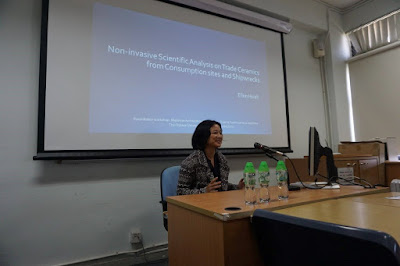
Dr. Ellen Hsieh
A ceramic-centered narrative is not enough to understand a shipwreck, argued by Dr. Brian Fahy, who agreed the importance of ceramics but also other often-neglected materials that could be found on shipwrecks. Dr. Fahy studied the materials that were excavated in six Southeast Asian shipwrecks and sites, namely Turiang, Bakau, Rang Kwien, Ko Si Chang III, Lena Shoal, and Santa Cruz. These materials include iron sand, tin ingots, Chinese coins, manufactured materials such as mirrors, armaments such as lantakas, sword and spearhead, net weight, fishing hook, duck egg, aniseed, peppercorns, minerals, beads, grinding stone, earthenware, and so forth. The study of these materials can serve for a better understanding of the social, economic and political context of the past. For instance, the rosette on the tin ingots found on Turiang, a shipwreck near to Malaysia, corresponds to the pattern on the money used in Malaysia. What does this phenomenon imply? What is the significance of the pattern? This may need further study, but it shows how these materials play a role in facilitating us to understand the past. With the consideration of the aforementioned materials, Dr. Fahy argued that it will give us a more complete picture of the networks as established by the ships back then.
Dr. Brian Fahy


Text: Sonia Fung Lok Shan

【星期五探討會回顧】臺灣文化資產中的窯業遺跡與傳世古陶瓷調查研究


日期: 29/9/2017
講者: 盧泰康教授 (國立台南藝術大學藝術史系)
題目: 臺灣文化資產中的窯業遺跡與傳世古陶瓷調查研究


盧教授以介紹三種不同的窯為線索,輔以詳實有趣的研究經歷,幫助聽眾理清台灣陶瓷業在不同歷史時期的發展脈絡。他先從瓦窯(即主要負責燒製烏瓦的窯)開始,提及建築材料燒製的特點:多就地取材,就地使用;少長途流通。各地燒製的特點造就不同地方的建築特徵:台灣的磚瓦多為紅色,著名的例子有台南的「赤崁樓」。

另外是漏窯以及糖漏的發掘和發現過程。糖漏是工業化製糖之前臺灣對紅糖進行脫色加工以生產白糖的重要用具。在文獻資料中,糖漏曾以「瓦溜」等一系列其他名稱出現。日治時代,殖民者對台灣糖業進行了工廠化改革,這種相對傳統且低效的脫色方式也逐漸被遺忘。漏窯的發現,包括糖漏、漏罐和底座等一系列器物的復原,彌補了這一世代記憶和考古材料上的缺環,讓研究者對明清時期的製糖工藝有更完整的理解。

第三種盧教授重點介紹蛇窯。盧教授結合自己在福建德化縣等地的考察經歷,從「蛇窯」、「龍窯」這些名稱上釐清台灣和福建地區窯業的關係。除了講解蛇窯的結構、運作原理和產品特徵外,盧教授重點介紹蛇窯在台灣各區的分佈及台灣文化資產普查工作的現狀。南投窯作為蛇窯在台灣的案例,盧教授從分佈在台灣各地寺廟的香爐入手分析南投窯的生產概況。根據統計數據清代和日治時期的香爐多於戰後,其反映南投窯生產規模和銷售範圍的縮小。從這個例子可以看出臺灣本土窯業和整體歷史進展的互動。


除此之外,雲林縣西螺鎮福興宮收藏的太平媽南投窯香爐也是另一個窯業研究物件。尤其是其中採用的不同科技手段,包括傳統的考古測繪、顯微放大鏡和螢光射線進行分析。通過顯微放大手段,我們可以知道香爐壁的文字是怎麼寫上去的,用切片釉層元素的測定結果讓我們能確定香爐的燒成溫度不會太高。盧教授的例子生動說明,各種科技手段在考古中應用可以讓考古發現和研究更加立體和全面,其背後代表的跨學科研究思維也是考古和歷史研究未來的發展趨勢。

講座結束之後,在場師生針對盧教授講座的內容,對台灣窯業和古代對外貿易之間的關係進行熱烈討論。

文:鄧曉懿