Friday, June 27, 2014

[Indian Culture Workshop 2013-2014] Session 6: Changing Indianness: Bollywood, music, and dance


Session #6: Changing Indianness: Bollywood, music, and dance
Speaker: Ms. Minaz Master


Indian movies have gained international attention in the last decades, and even earned a title, Bollywood. From the 3 Idiots to the first 3D dance movie ABCD: AnyBody Can Dance in 2013, the Indian cinema is surely a global sensation. Speaking of Bollywood, people would normally think about series of singing and dancing scenes, as well as colorful costumes and settings. This perception did nourish the birth of the Moulin Rouge!, which was an attempt for Hollywood to create something that resembles the Bollywood genre. Yet, if we take a look at some classics in the past decades, we will find the many transformations of Indian cinema. To be precise, this involves adding a lot of Westernized elements, while enforcing some of the Orientalist perceptions.

In this session, Ms Master showed us the constant change of Indian cinema, including the dance and music styles in it. She explained that the Indian cinema has been able to preserve some traditional Indian values, but at the same time also adopted some Western elements. Film is a powerful medium for us to understand Indian society which is in turn highly influenced by this medium.

Indeed, contemporary Indian cinema plays a powerful role in creating and shaping social identities, political orientations, as well as cultural values. Other than being joyful and delightful, Bollywood movies are also a medium to tackle critical social issues. Sensitive subjects such as sexuality, that are difficult to articulate in everyday contexts, are often a popular theme in Indian cinema. In Deepa Mehta’s Elements trilogy (Fire, Earth and Water), Fire became the first Indian movie explicitly dealing with homosexuality, and Water touched on the topic of widowhood. Indian film also plays a role at times of political turmoil. For instance, the 1957 classic Mother India uses a mother figure during a period of instability in India, to create a sense of security for the people.

Using Bollywood movies as a lens to look at social or cultural taboos provides a new way to intercultural understanding, and helps to debunk a lot of misconceptions. 

Ms. Minaz Master (far right) enjoying Indian cuisine with the participants after giving a talk on Bollywood movies


Wednesday, June 25, 2014

[In the Press] Prof. Sidney Cheung Talks About Foodways and Crayfish


source: www.cuhk.edu.hk
Prof. Sidney Cheung,  chairperson of the Department, was featured in article "We Are What We Eat: A CUHK anthropologist's angle on foodways and crayfish" on the website of The Chinese University of Hong Kong, talking about the determines of the diversity of Hong Kong foodways, as well as crayfish and its socio-economic implications in China. Click here to read the full article. 


"Food, as it involves culinary traditions, dietary rules and trends in consumption, clearly fits into contemporary anthropological concerns."


Wednesday, June 18, 2014

呂烈丹教授著作榮獲“2013年全國文化遺產十佳圖書”


Professor Tracey Liedan LU's book on rice and prehistoric cultural changes has been awarded as one of the 2013 10 best books on cultural heritage in China. For details please check the information below.

本系呂烈丹教授2013年初出版著作《稻作與史前文化演變》近期榮獲中國文物信息網2013年全國文化遺產十佳圖書”。本書相關內容介紹,可參見本博客之前的報導


Monday, June 16, 2014

[Indian Culture Workshop 2013-2014] Session 5: Festival of Lights- Diwali: Gender and Family


Session# 5: Festival of Lights- Diwali: Gender and Family
Speaker: Ms. Meera Rhoria

Ms Meera Rhoria was the speaker for the seminar on Diwali. She explained that, like Lunar New Year is one of the most important festivals in Chinese societies, the equivalent festival for Indians Is Diwali. Diwali is also called the festival of lights.  It is the biggest and most important festival of the year, and it gets its name from the row of oil lamps that Indians put outside their homes for the festival. These lights symbolize the inner light that protects people from spiritual darkness. It originated as a celebration that marks the last harvest of the year before winter. That is to say, the day after Diwali is the beginning of a new financial year. Thus, it is sometimes known as the Indian New Year.

Ms Rhoria said that if you travel to India during Diwali, you will have a very special experience-- lots of stores will be closed, but you will find tons of beautiful lights outside the homes.

Indians celebrate Diwali with family gatherings, glittering clay lamps, festive fireworks, strings of electric light bulbs, flowers, sweets, and of course the worship of Lakshmi—the goddess of wealth. Like the Chinese worship Choi Sun (the god of wealth), Indians believe that Lakshmi wanders the Earth looking for homes where she will be welcomed. People open their doors, windows, and most importantly, turn on the lights to invite Lakshmi in.

Meera also discussed how Diwali is related to gender relations and the concept of the family in Indian culture. While the celebration of Diwali symbolizes the importance of the family in Indian culture, the preparation work for Diwali reflects some of the gender preferences in Indian culture—women take care of the private sector, whereas men take care of the public sector. For Diwali, it is women who do most of the cooking and decoration, while men only occasionally help out.

Meera brought with her a silver chest and various decorations used for the altar at home, and demonstrated for us how the religious rituals are carried out in Indian homes. She explained that offerings are put in front of the family altar, or in front of the statue or picture of the goddess. These include flowers, fresh fruits, nuts, and sweets. Sweets, especially desserts made with flour, rice, and sugar are most important, as Indians believe that gods and goddesses love sweetness. As they offer the sweets to the goddess, worshippers pray to her for blessings throughout the year.


At the altar of Diwali, there are some gold or silver coins. Meera reminded us that this should not be misunderstood as  praying for money or being a bribe for the goddess. In fact, these coins or gold pieces are used to symbolize the rewards or results of hard work, which indeed share the same meaning as fruits and other offerings. People use them to thank the goddess for her blessings that have led them to success.

Ms. Meera Rhoria (front, 3rd from left) sharing on the cultural meaning of Diwali—the festival of lights 

Wednesday, June 11, 2014

Call for Papers: The 7th Annual CUHK Anthropology Postgraduate Student Forum


The 7th Annual CUHK Anthropology Postgraduate Student Forum

"Impacting the World: The Emerging Voices of Asian Anthropology"


The Department of Anthropology, Chinese University of Hong Kong, invites graduate students in Asia and elsewhere to present their current research at our 7th Postgraduate Student Forum: "Impacting the World: The Emerging Voices of Asian Anthropology". The Forum, to be held 23-24 January 2015 (Friday and Saturday) at The Chinese University of Hong Kong, will showcase the best of students’ contemporary research on Asia. 

Hong Kong is a global city, a major node for trade, investment, and the exchange of ideas. The Postgraduate Student Forum seeks to encourage the communication among young anthropologists in and of the East and Southeast Asian region, to help improve their research and to make the excellent research being conducted in Asia to be better known internationally. 

Presentations and Panels

We accept proposals for individual papers ONLY this year. Papers of different topics are welcome, ethnographic work preferred. Papers will then be organized into panels. Each paper presentation will last 15 minutes; PowerPoint and multimedia equipment will be provided. The language of the forum will be English. 

How to Apply

Application procedure and additional information can be found at http://www.cuhk.edu.hk/ant/pgforum7/index.html 
Deadline for abstracts is 30 September 2014
  

Forum Dates 

23-24 January 2015 (Friday and Saturday)  


For additional information, 
visit http://www.cuhk.edu.hk/ant/pgforum7/index.html or 
email anthforum@cuhk.edu.hk 
telephone: +852 3943 7670

Friday, June 6, 2014

Anthropologists on the Road Series(4): Living with Differences-- Lessons from a "Primitive Paradise"


As the world we live in has become increasingly globalized, it seems that more conflicts are reported due to ethnic and religious differences between people. At the meanwhile, when people constantly and consciously essentialize their differences, and draw boundaries between "us" and "them" accordingly, conflicts seem to have occurred because of the boundaries they have drawn. And thus a deepen awareness of these differences. 

However, this is apparently not the case in Bingzhongluo, a small township at North Western Yunnan Province. Our former assistant professor Wu Keping discovered through her anthropological fieldwork that, at this "primitive paradise", which is a multi-ethnic and multi-religious place, "there have been minimal ethnic conflicts and very few religious conflicts". How do the local people live with differences peacefully? And what could we "modern" people learn from these "primitive" peoples living in Bingzhongluo? 

To discover the full story, please click here and read Dr. Wu Keping's article "Living with Differences: Lessons from a 'Primitive Paradise'" published in Hong Kong Discovery (Vol 76), Anthropologists on the Road Series.   


Thursday, June 5, 2014

Department Newsletter - Spring 2014


The spring issue of the Department E-Newsletter has been published. Click here to catch up with us on our past season events, new publication and alumni updates!


Wednesday, May 28, 2014

徐渭芝博士明報月刊文章:跨境媽媽


        一談到「雙非子女」、「跨境媽媽」 ,香港人首先會想到「 衝關」急症室、分薄香港資灘和福利等。二零一三年底,終審法院裁定在香港居留不足七年的香港永久居民不能申請综援是違反《基本法》時,內地與香港的矛盾更趨激烈。
        本系徐渭芝博士基於其田野調查中的發現,於《明報月刊》專題下發表了文章“跨境媽媽”,試圖從跨境學童母親的角度來看中港矛盾議題,以及幫助讀者了解她們真實的在港生活。本文寫於終審法院判決前,有關部分跨境媽媽的心聲, 值得一讀。也許發出反對聲音的同時,也應該了解一下他們,從中或許找到辦法,既幫助他們,也帮助自己。

        “我們經常聽到中港跨境學童的報道, 其實香港還有一群跨境媽媽。
        內地孕婦在港產子後一般會帶回內地撫養,但過了幾年,家長便要考慮孩子入學問題, 模式大概有三個,一是在父母原居地生活及上學, 二是在深圳生活,孩子每天跨境上學,三是在香港生活及上學。本文所述的跨境媽媽, 正是第三種模式,媽媽跨境留港照顧在學小孩,而且都是基層出身。這種安排對基層家庭可說是極大考驗,為什麼她們要這樣選擇?她們最初又為什麼在香港生孩子?香港社會論述偏向視她們濫用福利和爭奪學位,本文試從她們的角度去看,以及了解她們在港的生活。”…… 點擊下圖閱讀全文。


Friday, May 23, 2014

[Event] Understanding Kodo and Kyogen from two Japanese Masters


On May 7 and 8, a Japanese Kodo (香道) and Kyogen (狂言) Demonstration was co-organised by The Department of Anthropology and the Institute of Future Cities' (IOFC) Centre of Urban History, Culture and Media.


Mr. Hachiya Souhitsu, a designated Iemoto of Shinoryu Kodo, and Mr. Nomura Matasaburo, a Nohgaku actor and Izumi style Kyogen master, were invited to share with participants the traditional Japanese art of Kodo and Kyogen.


Mr. Hachiya, designated Iemoto of Shinoryu Kodo, shared with us the history of Japanese Kodo and the challenges faced by traditional arts in a modern world.

Incense appreciation.

Mr. Nomura is an Izumi style Kyogen master of Japan. Since 2011, he has become the 14th Kyogen master to successively bear the name of Nomura Matasaburo. He performed at the Royal wedding ceremony of the Crown Prince and Princess of Japan, and has also participated in the Hollywood movie The Last Samurai and an NHK drama broadcasted in 2013.

A Kyogen demonstration by Mr. Nomura and his son. Traditional arts are passed down from generation to generation. And Mr. Nomura's son may inherit the role as Kyogen master in the future.

Mr. Nomura sharing his Kyogen costume collection with us.

As we listened to Mr. Hachiya and Mr. Nomura's stories, we were overwhelmed by their persistence to preserve and promote traditional arts, and start rethinking the preservation of traditional craftsmanship and arts in our local history and culture, as well as the costs of economic development. 

What is the value of history, heritage and traditions in the modern society? Why are they important, especially when we are planning for the future? Maybe these are the questions left for the participants and us.

Wednesday, May 21, 2014

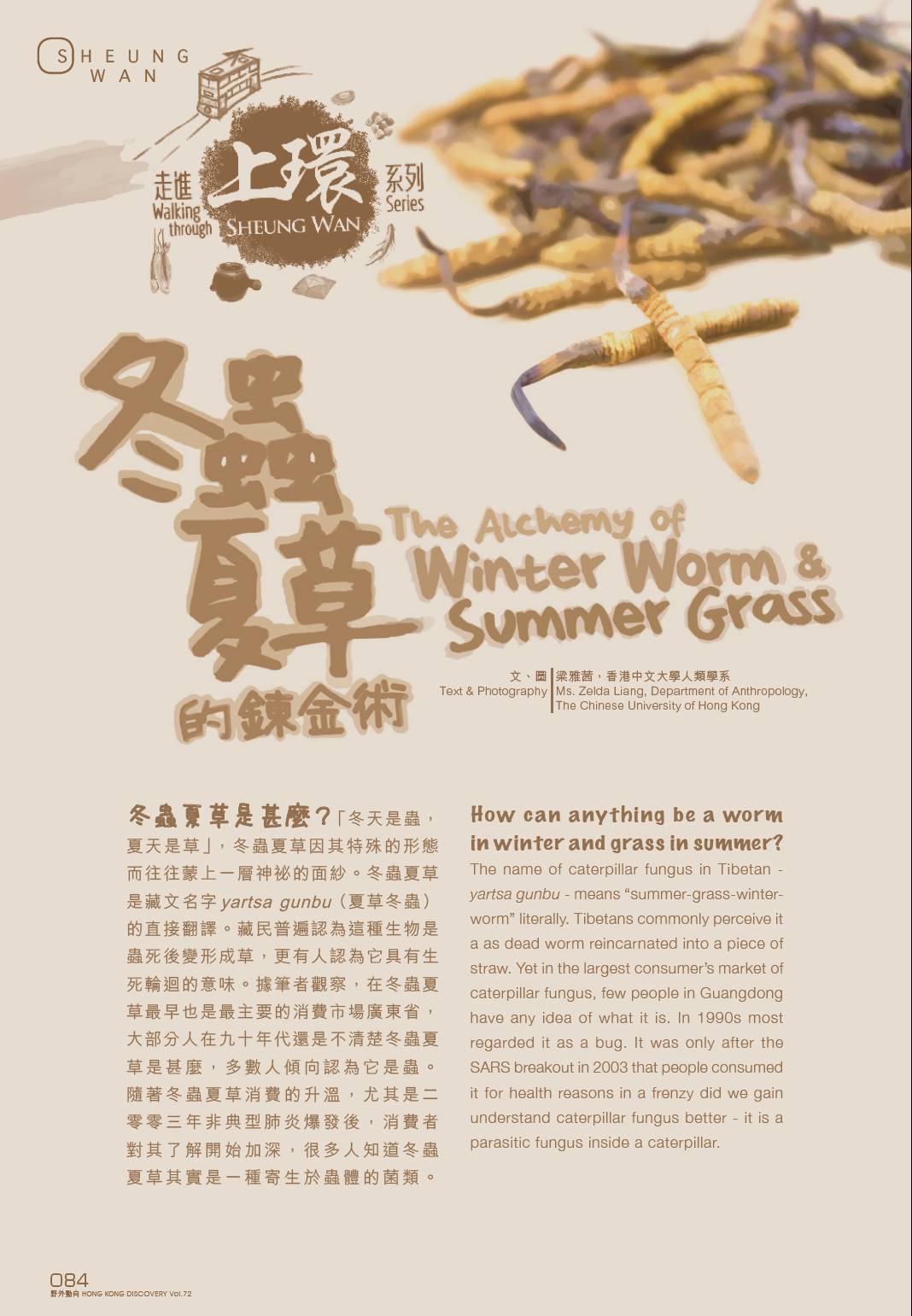
Walking through Sheung Wan Series(1): The Alchemy of Winter Worm & Summer Grass


What is "winter worm & summer grass"? How could anything in the world be a "worm in winter and grass in summer"? Well, first of all, it is actually a parasitic fungus inside a caterpillar. But then what has caused its bloom in the market? Is it purely due to its "medical values"? What roles did political economy and culture played in this process? How did the fungi rose from a total disfavor to such a golden value in just a few decades? What role did Hong Kong played in this metamorphosis? And how has the "All-Tibetan Gold Rush" for fungi in recent years affect the local ecology and society in Tibet?

In her article "The Alchemy of Winter Worm & Summer Grass", our former MPhil student Zelda Liang discussed the above issues based on her research. Click the picture below to see the full article in Hong Kong Discovery (Vol 72), Walking through Sheung Wan Series.